.png)


GRIMA for Hancocks, London, UK: When the Stone Shapes the Jewel


Hancocks London and GRIMA have approached their new collaboration from opposite ends of the jewelry-making process. Hancocks brought together a selection of old-cut diamonds and gemstones; Francesca Grima then designed around them. Three years later, the result is a five-jewel collection that puts unusual stones, architectural settings and London craftsmanship on equal footing.
The five pieces do not form a conventional suite. There is no single motif running through them, nor an obvious attempt to make one jewel look like another. What connects the collection is the way Grima responds to the character of each stone, allowing proportion, cut and color to determine the structure around it. The settings are often as visually important as the gems they hold.
That makes the collaboration an interesting meeting of two established areas of expertise. Hancocks has a particular interest in antique and old-cut diamonds and in sourcing stones with individual character. GRIMA, under Francesca Grima, is known for a more sculptural approach, where gold and precious stones are used to create volume, movement and architectural form. Here, the two are not competing ideas. The stone provides the starting point, and the setting becomes the answer.
Old-cut diamonds are particularly suited to this approach because they are rarely identical in the way a collection of standardized modern stones might be. Their proportions, facet arrangements and optical character vary from one stone to another. Designing around them means responding to what is actually there rather than working from a fixed template.
One of the clearest examples is the 3.70-carat vintage Asscher-cut diamond paired with a 4.08-carat Colombian emerald. The earrings are deliberately asymmetric, with baguette, carré and bullet-cut diamonds set into 18-carat yellow gold and platinum. The bullet cuts, traditionally supporting stones, have been moved to the ends of elongated gold batons, giving them a more prominent architectural role.
The same attention to structure appears in a ring centered on a 5.07-carat antique pear brilliant-cut diamond. Set east-west in 18-carat yellow gold, the stone sits within a dimensional, castellated setting punctuated by French-cut diamonds. The inspiration comes from Trellick Tower at night, with the small rectangular diamonds recalling illuminated windows across the building's facade.
Architecture appears elsewhere, but always as a design problem rather than a decorative reference. The convertible earrings, set with 8.19 carats of French-cut diamonds in platinum, draw from the ceiling of an Oscar Niemeyer auditorium in Paris. Their geometry explores repetition, depth and reflection, while detachable drops allow the proportions of the earrings to change.
French-cut diamonds are an important part of the collection's visual vocabulary. Their straight edges and rectangular geometry allow them to behave almost like building materials within the settings. They create borders, interruptions and stepped patterns, giving the jewelry a graphic quality that differs from the softer brilliance of round stones.
The use of yellow gold and platinum adds another contrast. Rather than relying on highly polished metal throughout, several of the pieces use brushed-satin finishes. The surfaces become quieter, allowing the gemstones and the construction of the settings to carry more of the visual weight.
The most unconventional piece may be The Dress Set, which moves jewelry away from the traditional ring, necklace or earring format. Beginning with the shape of cowboy collar tips, Grima has reworked the idea of a formal dress set into a group of adaptable pieces. Two clips can be joined to form a brooch, while the set also includes cufflinks and three dress buttons. Each element can be worn separately or together.
It is a useful example of how the collection treats jewelry as something that can be configured rather than simply worn in one prescribed way. The idea of adaptability also appears in the convertible earrings, where removing the drops changes the scale and presence of the jewel.
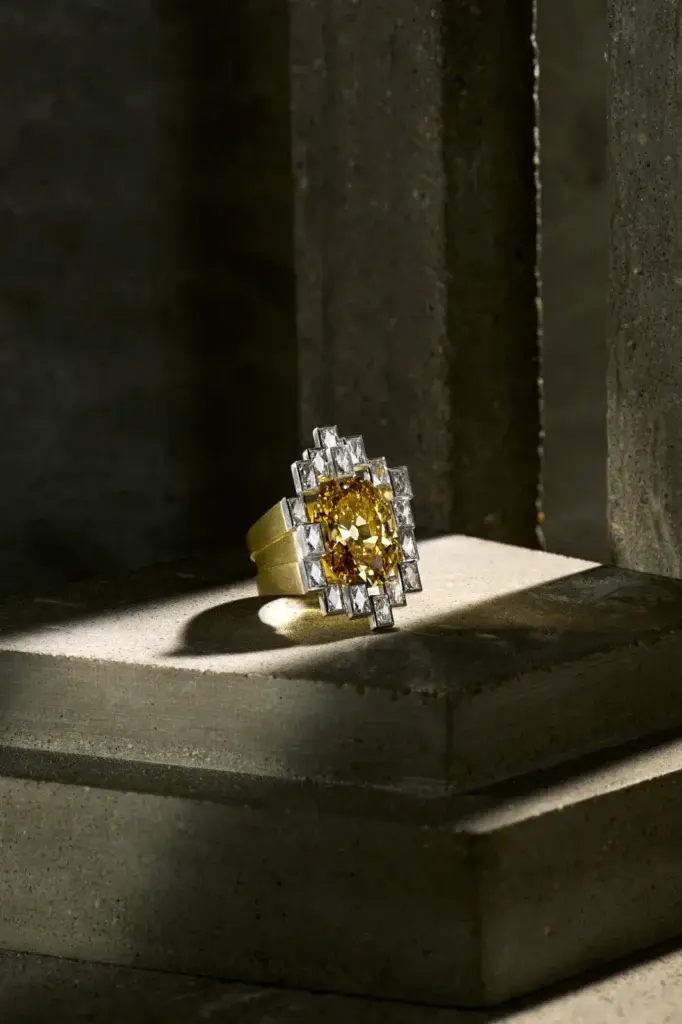
At the other end of the collection is an 11.15-carat Fancy Deep Brownish Yellow VVS2 old-cut oval diamond. Its combination of golden and brown tones gives the stone its cognac character. Instead of enclosing it within a conventional symmetrical halo, Grima has surrounded it with 2.24 carats of French-cut diamonds in an asymmetric arrangement. With no visible claws, the central stone appears to sit within the surrounding structure rather than being visibly held by it.
This is where the collection becomes most interesting. The gemstones are substantial, but their size alone is not the point. The design continually asks what should happen around them. How much structure is necessary? Where should the metal stop? How can smaller diamonds become part of the architecture rather than simply add brilliance? How can an old-cut stone retain its individual character once it becomes part of a new jewel?
The answers vary across the five pieces.
The collaboration also has a history behind it. Francesca Grima and Amy Burton-Totton, Hancocks' Creative Director, have a longstanding friendship, while the relationship between the Grima and Burton families extends across generations. That connection gives the project a sense of continuity, but the jewelry itself is firmly contemporary.
The craftsmanship reinforces that position. Each of the five jewels was handmade in London by a single master goldsmith, with the makers' marks of both GRIMA and Hancocks placed side by side. Keeping each jewel with one master maker gives the process a degree of continuity that would be difficult to achieve through a more divided production system.
There is a certain restraint in the way the collection has been edited. Five pieces are enough to demonstrate the range of the collaboration without turning it into a broad seasonal exercise. The jewels move from asymmetric earrings to architectural rings, from convertible forms to a multi-part dress set, but all remain tied to the same underlying principles: exceptional stones, considered construction and an emphasis on the hand behind the work.
The result is contemporary British jewelry that does not depend on a single decorative signature. Instead, the collection is held together by a method of designing. Hancocks' stones are treated as individual starting points, while Grima's settings give each one a distinct architectural response.
That relationship between gemstone and structure is ultimately what gives GRIMA for Hancocks its character. The diamonds and emerald are not simply the precious ingredients of the jewelry. They determine where the design begins. What follows is a process of cutting, shaping, setting and making that turns each stone into something with its own proportions, movement and presence.
Brand Website: Hancocks London


