.png)


Against the Clock: How Maximilian Büsser Stopped Making Watches and Started Making History
Updated: Jun 7

Before he built MB&F, Maximilian Büsser grew Harry Winston's watchmaking revenue tenfold, ran one of the most coveted jobs in Swiss horology, and was, by every visible measure, exactly where a career like his was supposed to end up. He walked away anyway. Twenty years on, his pieces sell at Christie's for over half a million dollars, Chanel holds a stake in his company, and the industry that once had no category for what he was making now considers him among the most significant independent watchmakers alive. We spoke to him about pride, creative courage, and the only compass he has ever followed.
The question that matters most about Maximilian Büsser is not why he eventually built MB&F but why, having built a career of genuine institutional distinction, he chose to walk away from it at the moment when most people in his position would have stayed. He had grown Harry Winston Rare Timepieces from eight million dollars in revenue to eighty million over seven years as its CEO, a performance that would have justified staying indefinitely and collecting whatever recognition and compensation came with it. He had created the Opus series there, a groundbreaking collection of ultra-complicated mechanical watches made in collaboration with the world's most respected independent watchmakers, which became the direct creative precursor to everything MB&F would eventually become. He was, in other words, not leaving because he had failed or because the institutions had failed him. He was leaving from the summit of precisely the career those institutions had promised, because from that summit the view had become uncomfortable in ways he could no longer ignore.


He studied microtechnology engineering at the École Polytechnique Fédérale de Lausanne, graduating in 1991 with every intention of joining the kind of large international corporation that engineering from a Swiss federal polytechnic was supposed to deliver. It was Henry-John Belmont, the then-CEO of Jaeger-LeCoultre, who redirected that trajectory with a question that Büsser has never forgotten. "Did he want to be one among 200,000 in a big corporation," Belmont asked, "or among the four or five of us who can save this beautiful company?" He joined Jaeger-LeCoultre. Seven years later he was headhunted to run Harry Winston. And then, in 2005, at the age of thirty-eight, he left to build something the watchmaking world had no vocabulary for. "I had become a marketer," he says, "and at some point I hated myself for it. I felt disconnected from what I truly believed in."
"I had become a marketer, and at some point I hated myself for it. I felt disconnected from what I truly believed in."
What followed was not a strategic reinvention or a carefully managed transition but something considerably more personal and more costly than either of those things. He left, and then he built MB&F, which stands for Max Büsser and Friends, a name that no brand consultant would have arrived at and that is deliberately, almost defiantly, free of institutional authority. It announces from its very first letter that you are dealing with a person rather than a corporation, and that this person has chosen to build in the company of others rather than in the isolation that a founding ego so often demands. Büsser has deliberately capped the MB&F headcount at twenty people, a decision rooted in a conviction that management layers are actively detrimental to creativity and that keeping the organization small enough to remain genuinely alive is itself a form of creative discipline. The majority of the brand's watches sell for upwards of fifty thousand dollars. The most significant auction results approach seven figures. In 2022, the LM Sequential EVO won the Aiguille d'Or at the Grand Prix d'Horlogerie de Genève, the highest prize in watchmaking. In 2024, Chanel acquired a twenty-five percent stake in the company. Büsser retains the majority and, more importantly, complete creative control.
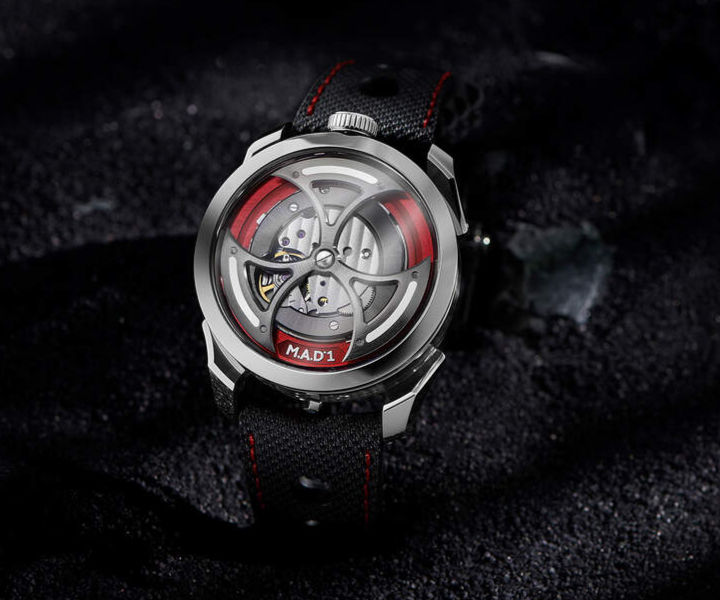
None of that was predictable in 2005, and he does not pretend otherwise. The early years of MB&F were not, despite the recognition that eventually came, a period of straightforward progress. Building something independent on an unconventional premise inside a profoundly conservative industry carries a weight that institutional careers are specifically designed to protect people from, and Büsser does not romanticize what those years actually felt like from the inside. There were stretches of genuine doubt, periods when the path felt uncertain in ways that went beyond the romantic uncertainty of a bold creative venture and became simply uncomfortable. "When you start something independent, uncertainty is part of the journey," he says. "There were times when things felt very fragile." What sustained him through those periods was not external validation or market traction or the reassurance of peers, but something far more immediate. Finishing a piece and watching the emotion it produced in the person encountering it for the first time. That feeling, he says, was always sufficient to continue.

The name matters, and so does the philosophy embedded in it. Collaboration has never been for Büsser a practical necessity but a belief, a conviction that creative work reaches places in the company of different intelligences that it cannot reach alone. "Collaboration takes you to places you could never reach alone," he says. "Every friend brings a different sensitivity, a different expertise, and a different way of seeing the world. When those perspectives meet, something unexpected often happens — and that's usually where the magic is." The Friends over the years have included some of the most respected independent watchmakers and designers working in the field, each collaboration producing something that neither party could have arrived at independently, which is the precise definition of what Büsser means by the word.
"We never start by asking what the market wants or what the trends are. That would be the fastest way to lose our soul."
Büsser trained as an engineer rather than a watchmaker, and that distinction runs through everything MB&F has produced in ways that are not immediately obvious but become impossible to ignore once understood. A watchmaker begins with centuries of accumulated form and tradition, with the inherited assumption of what a watch is and what it is for, and works forward from that foundation. An engineer begins with the problem, or, in his case, with the dream. The pieces that have emerged from the M.A.D. House, MB&F's atelier in the Carouge neighborhood of Geneva, have been described as spacecraft, as sculptures, as science fiction made material, and all of those descriptions are partially accurate and entirely insufficient at the same time. They tell time. But time, as Büsser frames it, has become part of the narrative of what MB&F makes rather than its organizing purpose. "What fascinated me more was the machine itself," he says. "Its architecture, the way it moves, and the emotion it can create." The timekeeping is real and precise and entirely non-negotiable. It is simply no longer the point around which everything else arranges itself.


What the organizing principle actually is, if you spend enough time with him, is something he has carried since childhood. Spaceships. Strange machines. The science fiction of a boy who had not yet been told what was and was not possible and who, crucially, never entirely agreed to update that position as adulthood and professional life came to claim their usual territory. His mother was a Parsi Zoroastrian, and he has spoken in other contexts of her profound influence on the person he became, on the particular quality of conviction and stubbornness with which he has pursued his own path rather than the one laid out for him. Many people carry vivid memories of what captivated them at ten years old. Very few build an entire creative enterprise around the refusal to leave it behind. "I think MB&F is in many ways a continuation of those childhood dreams," he says, and what is striking about the statement is its literalness. He is not speaking poetically about maintaining a sense of wonder. He is describing a direct and unbroken line between a boy's imagination and the objects currently being assembled in his atelier, a line that was never severed because he made a succession of choices, at significant personal and professional cost, to protect it.
Protecting it requires navigating a tension that would be paralysing for most people working in any precision discipline. Watchmaking operates at tolerances that are microscopic and unforgiving, where the consequences of approximation are permanent and visible in the finished object. As Büsser has learned over two decades at MB&F, creativity almost never starts with precision. It begins somewhere considerably looser and stranger, sometimes in a direction that is entirely impractical until quite suddenly it becomes practical. "It usually begins with something quite free — sometimes even a little crazy," he says. "The challenge is to protect that freedom while making sure the final machine works perfectly." What he is describing is not a compromise between imagination and engineering but a deliberate and hard-won sequencing of them, a discipline of allowing the dream to run ahead for as long as possible before the rigor catches up to make it real. Protecting the beginning, in his telling, is the hardest part of the entire process. The engineering problems, however complex, can eventually be solved through application and expertise. The original impulse, once surrendered to caution, almost never returns in the same form.
"Success can easily make you comfortable, and comfort is dangerous for creativity."
In 2011, Büsser founded the first M.A.D. Gallery in Geneva, a physical argument that the objects MB&F produces belong in an art context as naturally as a horological one. M.A.D. stands for Mechanical Art Devices. The gallery displays MB&F machines alongside kinetic art from makers around the world, and the proposition it embodies, that these objects are a form of sculpture as much as they are a form of watchmaking, has since been extended to locations in Dubai, Taipei, and Hong Kong. Büsser himself has called Dubai home since 2014. In 2018, he was awarded the Prix Gaïa Spirit of Enterprise by the Fondation du Musée d'Horlogerie, the watchmaking industry's recognition that what he had built represented not just creative achievement but a genuinely new way of conceiving what a watch company could be.
What success means to him has shifted considerably over the two decades since MB&F's founding, and the direction of that shift is not what one might expect. Initially it meant survival and proof of concept, evidence that the idea could exist in the world and find its people. Today, with Chanel as a minority partner and pieces commanding serious auction results, it means something that requires more vigilance rather than less. "It means protecting the creative spirit of MB&F," he says, "and continuing to create things we genuinely believe in." The risk he is most alert to now is not failure in any conventional sense but the particular kind of creative erosion that success alone can produce. Comfort. The way an enterprise that has proven itself can begin to inhabit what it already knows how to do, rounding off the edges that gave it its particular energy in the first place. "Success can easily make you comfortable," he says, "and comfort is dangerous for creativity."
The market, throughout all of this, is not a compass he consults and never has been. "We never start by asking what the market wants or what the trends are," he says. "That would be the fastest way to lose our soul. We simply try to create objects that we love and that we are proud of. If we believe something deserves to exist, we build it. That's really the only compass we follow." This approach produces, as a natural consequence rather than a positioning strategy, objects that do not belong to any particular moment or trend cycle. They exist outside the time of their making, while being, in every technical and material sense, entirely and precisely about time itself; a paradox he appears to find more generative than troubling. How future generations will understand the work, separated from the conversations and context in which it was made, is a question he holds without apparent anxiety. "I don't try to control how our work will be interpreted in the future," he says. "I simply hope that people will still feel the sincerity behind these pieces—that they were created with passion and honesty."
Curiosity, he says, remains the primary driver. It's not just managing a legacy or stewarding a reputation built over twenty years; it's the active desire to explore, to experiment, and to sit inside the genuine possibility of failing rather than at a careful distance from it. Alongside that now sits a sense of responsibility toward the people within the laboratory, toward the collaborators whose creative trust he holds, and toward the community of collectors he calls the Tribe, who have followed MB&F since the first Horological Machine appeared in 2007. But it is the curiosity that initiates each new thing, and it is pride, that original and uncomplicated goal he set for himself at the very beginning, that tells him when the thing is finished.

He hopes, when the work is eventually encountered by people who know nothing of how or why or by whom it was made, that it will function as an argument. It is not for any particular aesthetic position or technical achievement, but for something more fundamental. "The reason MB&F exists," he says, "is to inspire people to follow their own path — to take more risks, to think differently, and hopefully to find their own true north." It is a generous ambition for a laboratory whose pieces begin at fifty thousand dollars and exist in editions small enough to make them genuinely rare. But the argument MB&F makes has never been contained in the price or the exclusivity or the auction result. It has always been contained in the choice Büsser made when he walked away from a career that grew Harry Winston tenfold and looked exactly like success from the outside because from the inside it felt like nothing of the sort. That choice is visible in every piece the laboratory has made since. It is, ultimately, what makes them worth looking at.
MB&F timepieces are available at select authorized retailers globally, at M.A.D. Galleries in Geneva, Dubai, Taipei and Hong Kong, and at mbandf.com


