.png)


Portside: A Californian Retreat on the Pacific Ocean


Portside House La Jolla
Portside is a residential project in La Jolla, California, completed in 2025 by architect and interior designer Daniel Joseph Chenin. The original building, a 1950s structure sitting directly on the Pacific coastline, could not be demolished and entirely rebuilt due to restrictions imposed by the California Coastal Commission. The house was instead stripped back to its essential structure and reimagined entirely from within, working within the original volumetric footprint. The constraint shaped the project fundamentally: every decision about space, light and material had to work harder within fixed boundaries.
The exterior reads as a considered composition of contrasting materials. Dark vertical timber cladding covers the street-facing facade, while large format travertine stone panels wrap the side and courtyard-facing walls. A copper roof sits above, its patina shifting against the sky. A stone Buddha sculpture on a plinth marks the entrance, and the approach through a reeded glass door opens into a through-passage that frames the Pacific directly ahead before a single interior space has been entered.
The central courtyard is the organizational hinge of the plan. Walled in travertine on three sides with full-height glazed sliding doors on the fourth opening into the living spaces, it contains a cloud-pruned pine tree as its primary element, surrounded by gravel planting and low drought-tolerant groundcover. The courtyard brings morning light deep into the interior and provides the plan with a quiet, contained outdoor room at its core. From the primary bathroom, a picture window frames the courtyard directly, placing the tree in view from the bath.
The living room occupies the primary ocean-facing position. Corner glazing on two sides places the Pacific on full display, with black-framed floor-to-ceiling windows bringing in the horizon at the same level as the seating. The ceiling is clad in oak panels laid in a geometric pattern, slightly sloped in profile, a reference to the hull of a ship that becomes readable when you look at how the timber planes meet at the perimeter. Furniture is kept low and unassertive: a large cream sofa, dark leather armchairs, a glass-topped oval coffee table. Two landscape-format paintings in warm earth tones hang on the wall adjacent to the windows, their palette pulled from the sand and coastal scrub visible outside. A secondary sitting room works in a quieter register with a white boucle sofa, a round wood and brass coffee table, and a large-scale abstract painting on the rear wall in greens, burgundy and gold. The courtyard pine is visible through the glazed door at the end of this room, tying the two ends of the house together through a single repeated view.

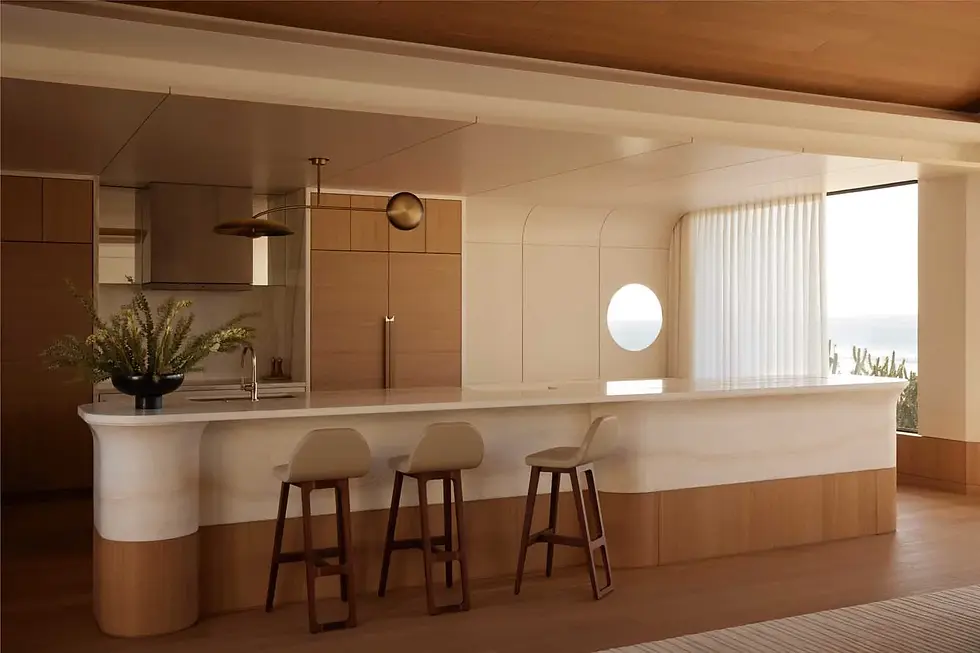
The kitchen and dining zone is where the nautical references become most explicit. The kitchen island is a long onyx form with a stone top and a wood-paneled lower section, its ends rounded and its profile low. Bar stools in dark timber with upholstered seats line one side. The circular porthole window punched through the dividing wall between the kitchen and the breakfast nook is the most direct reference in the house to its coastal setting, framing a disc of ocean and sky like a painting that changes with the weather. The breakfast nook itself is a curved built-in banquette in cream with a round table on a dark tapered base, placed directly against full-height glazing to the ocean. The kitchen cooking wall uses oak cabinetry with a stone backsplash and a metal range hood that reads as a clean, functional object rather than a decorative one.
The primary bedroom sits at the far end of the house on the ocean side. Oak paneling runs floor to ceiling across the walls and ceiling, wrapping the room in a consistent warm material. An upholstered headboard in vertical channel detail spans the full width of the bed wall, framed by matching bedside tables and lamps. Full-height glazed doors open directly to the ocean terrace, where a planted boundary of euphorbia and coastal vegetation sits between the terrace edge and the beach below. A sculptural bronze ceiling fixture with organic blade-like arms spreads above the bed. The passage from the bedroom through to the dressing room and bathroom moves through a marble-floored corridor where the material changes from warm oak to cool stone, with the dressing room to one side featuring floor-to-ceiling oak and glass cabinets with polished metal hardware, and two upholstered ottomans on the floor below.
The primary bathroom is the most materially intensive space in the house. Arabescato marble runs across the floor, walls and ceiling in continuous slabs, the veining matched across surfaces. The double vanity is a custom piece: a pale lacquered cabinet on a polished metal frame with a dark stone top, flanked by full-height mirror panels set between marble piers. Sculptural metal wall sconces in a branch-like form are mounted directly onto the marble. The soaking tub is set into the marble floor beneath the picture window looking onto the courtyard, with the pine tree directly in view.
The powder room is the house's most individually composed space. An onyx-effect warm pink stone wraps the walls, and a deep green marble basin is set into a recessed niche. Above it, a steel porthole-shaped mirror in a thick rounded frame contains a painted interior depicting a school of fish moving through water, referencing the underwater world visible just offshore. Two ceramic flower-form pendant lights hang above. The combination of the green basin, the warm stone, the porthole form and the painted fish interior gives the room a specific and considered character distinct from the rest of the house.
The ocean-facing terrace runs the full width of the living spaces. A low parapet wall topped with planted euphorbia forms the boundary, with an outdoor dining table and folding director's chairs in dark timber positioned to face the beach and the La Jolla coastline stretching south. The terrace is photographed at sunset, the sky behind the headland turning amber and the surfers still in the water below.