.png)


The Best Air Purifiers India Has Right Now
Updated: Aug 11

A buyer's guide to breathing cleaner air at home, and eleven machines worth your money
The eleven air purifiers in this piece appear in no particular order, and nothing should be read into where any of them falls, because we have not ranked them and the sequence is deliberately random. The reason is simple enough: the right purifier for you depends entirely on your room, your budget and the particular problem you are trying to solve, and a machine that is ideal for a small bedroom would be both wasteful and underpowered in an open-plan living room. It makes far more sense to read the guide first, work out what your home actually needs, and then look at the machines through that lens, rather than assuming the one nearest the top is the one to buy.
The reason any of this matters is not in dispute. India is home to a striking share of the world's most polluted cities, and through the winter months, particularly across the north, PM2.5 levels routinely climb to many times the limit the World Health Organization considers safe, spiking further during the stubble-burning season when the air in Delhi and its neighbours becomes genuinely hazardous. An air purifier does not solve that, it cannot clean the air outside your walls, but within a closed room it can make a real and measurable difference to what you and your family breathe for the hours you spend indoors, which for most people is the majority of the day.
The only specifications that genuinely matter
The marketing around air purifiers is dense with numbers and features, most of which are noise. In practice, four things decide whether a purifier will actually work for you, and everything else is secondary.
The first is the filter. The term to look for is True HEPA, and specifically the H13 grade, which captures around 99.95 percent of fine particles down to the 0.3 micron size that matters most for PM2.5. Be wary of anything described only as "HEPA-type" or "HEPA-like," which is often a lower H11 grade that captures closer to 95 percent, a meaningful gap in Delhi-grade pollution. A True HEPA H13 filter is the realistic minimum you should accept. For a household with a severe asthma or respiratory condition, an H14 filter goes further still, though for most homes it is more than necessary. Just as important, and frequently overlooked, is a genuine activated carbon layer, because HEPA alone traps particles but does nothing about gases, cooking fumes or smoke odour, and in Indian kitchens that carbon layer saturates faster and needs replacing on schedule regardless of what the indicator light says.
The second is CADR, the Clean Air Delivery Rate, usually quoted in cubic metres per hour, which tells you how quickly the machine actually delivers clean air. This is the single most useful number on the box, because a high-grade filter is pointless if the fan cannot move enough air through it. For a typical Indian bedroom of around 130 to 150 square feet, look for a CADR of at least 200. For a living room of 250 to 350 square feet, aim for 300 or more. Anything below about 180 is, in serious pollution, close to a token gesture.
The third is matching that CADR to your actual room, and here there is a trap worth knowing. Manufacturers quote optimistic coverage figures, so a sensible rule is to mentally reduce the stated coverage by around 30 percent and buy for the room you have rather than the one on the label. A simple working formula, if you prefer, is to multiply the CADR by roughly 1.5 to get the maximum room size in square feet the machine can genuinely handle. Undersizing is the most common and most frustrating mistake, because a purifier that is too small for its room runs flat out and loud all the time, cleans slowly, and wears out its filter faster, which quietly raises your running costs.
The fourth is that running cost itself, which most buyers discover only after the fact. The purifier's electricity use is generally low, but the filter is a recurring expense, typically needing replacement every six to twelve months at somewhere between ₹1,500 and ₹4,000 depending on the model. Before you buy, find out what a replacement filter costs and how easily you can get one, because a cheap machine with expensive or hard-to-source filters can end up costing more over a few years than a pricier one with affordable, long-life filters.
A few things worth knowing before you spend
Placement changes performance more than most people realise. A floor-standing purifier works best near the centre of a room, not tucked into a corner behind furniture, since the closer it sits to the middle, the more of the room's air it can actually reach. If your only power socket forces it into a corner, accept that you are losing some of its rated performance.
Be sceptical of gimmicks, and actively avoid one. Ozone-generating purifiers, sometimes sold on the promise of "fresh" air, can worsen asthma and respiratory conditions, and are best left alone entirely. Ionisers are a mixed bag and not a substitute for proper filtration. A UV stage can be a reasonable addition for someone particularly concerned about germs, but it is the HEPA and carbon that do the real work.
Finally, decide honestly what you are buying for. A quiet machine that runs below around 28 decibels is worth prioritising for a bedroom, where it will run all night. A high smoke CADR matters most if you cook a lot or live where the winter air turns severe. And design, quiet operation and the convenience of a machine that also moves air around the room are genuine reasons some people pay a premium, as long as you know that is what you are paying for, rather than for better filtration alone.
Eleven air purifiers worth considering, in no particular order
Prices move constantly with sales and offers, so treat every figure below as an approximate guide and confirm the current price and availability before buying.
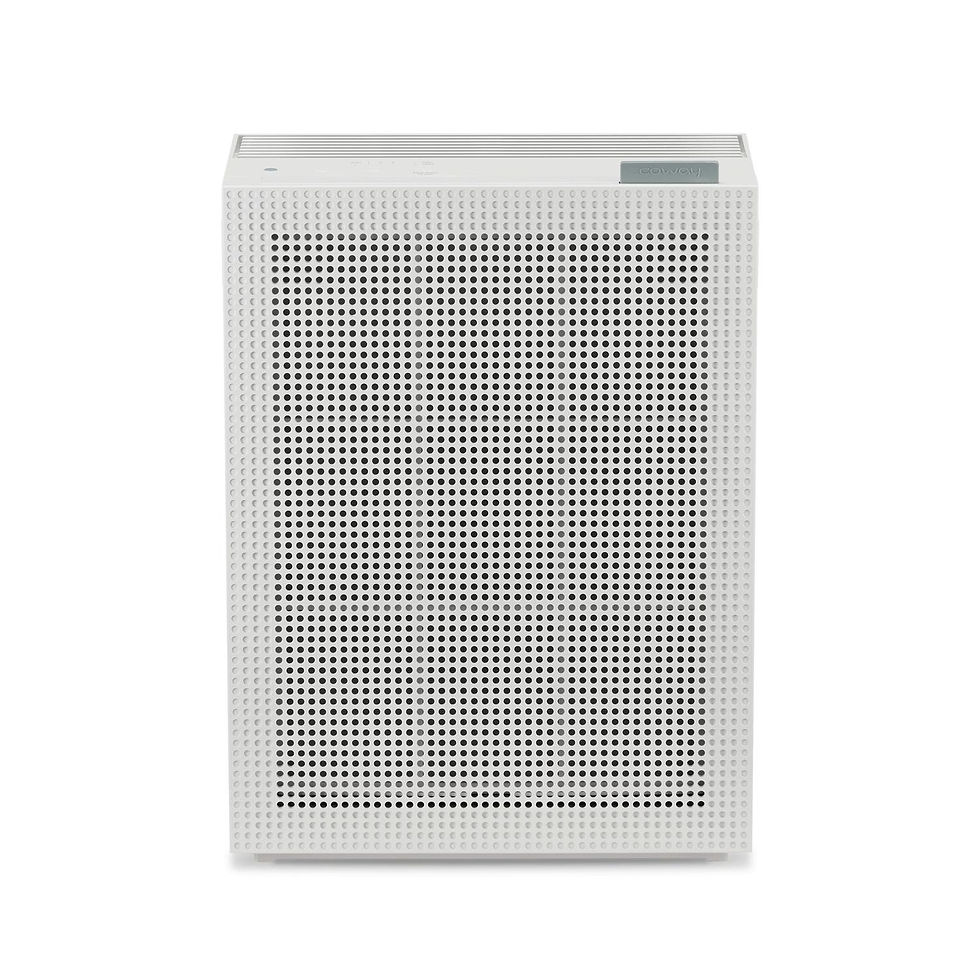
The Coway Airmega 150 is a widely recommended all-rounder, with a True HEPA H13 filter, a CADR of around 303, and a notably long filter life, which makes it a strong choice for a bedroom or a medium-sized room. It runs quietly, and its long-life filter helps keep running costs sensible over time.

The Philips AC3220/60, from the PureProtect 3200 series, is one of the higher-output machines on this list at a reasonable price, with a CADR of around 520 and coverage the brand rates for large single rooms and studio apartments, along with HEPA and activated carbon filtration. It suits a bigger living space that a compact unit would struggle with.

The Xiaomi Smart Air Purifier 4 is the value-led smart pick, with a CADR of around 387 to 400, full app control with real-time air-quality monitoring, and, importantly, some of the cheapest replacement filters around, which keeps its long-term cost low. It is the natural choice for someone who wants app-based monitoring without paying a premium for it.

The Honeywell Air Touch V5 sits in the mid-range with a CADR of around 380, a long filter life, and a reputation for holding up well in heavy northern pollution, making it a dependable pick for a living room in a high-pollution city.

The Honeywell Air Touch V1 is the budget entry that still insists on genuine H13 HEPA rather than a cheaper alternative, at a CADR of around 152 and coverage suited to small rooms. It is the pick for the tightest budget that refuses to compromise on true filtration, provided you check its coverage carefully against your actual room size.

The AGARO Royal is the value pick on this list, and a genuinely capable one, with a True HEPA H13 filter, a CADR of around 300 and coverage suited to a medium room, frequently available well below its listed price, which makes it one of the most cost-effective ways into proper H13 filtration. AGARO also makes a step-up Imperial model with an H14 filter and a seven-stage system for those who want higher-grade filtration, though as with any value brand it is worth confirming that replacement filters are easily available in your city before you commit, since that is the one point buyers of this kind most often overlook.

The Dyson HushJet Compact HJ10 is the premium design-led option, using a sealed electrostatic filter rated at 99.97 percent efficiency down to 0.3 microns, with exceptionally quiet operation and a very long filter interval that makes its annual filter cost more competitive than the price suggests. The honest caveat is that its premium is hard to justify on filtration alone, since cheaper machines handle Indian PM2.5 effectively, so it makes sense mainly if design and near-silence matter to you as much as clean air.

The Coway Airmega 250 is the step up for larger and more polluted spaces, with high coverage, a long filter life and a lengthy warranty, built to handle the extreme end of Delhi's winter without constant filter changes. It is a sensible choice for a large living area in a severe-pollution city.

The Karban Airzone Pure takes a different approach as a ceiling-mounted purifier that also works as a bladeless air circulator with a dimmable light, actively moving air through its HEPA filter rather than sitting stationary in a corner, with a CADR of around 250 and no floor footprint. It suits those who want a permanent, space-saving, whole-room solution, and it can double up as a replacement for a ceiling fan and light.

The Blueair mid-tier range is worth a look for its strong filtration reputation and a CADR in the region of 400, sitting in an accessible mid-price band, though as with any model you should confirm the exact specification and current price against the official listing before buying.

The Honeywell Air Touch U2 is the choice for the largest spaces, with one of the highest CADR figures on this list, rated for very large coverage, which means a single well-placed unit can handle an entire open-plan living and dining area rather than needing two machines.
The honest bottom line
For most homes, the sweet spot is a mid-range machine with a True HEPA H13 filter and a genuine carbon layer, correctly sized to the room, which will generally cost somewhere between ₹16,000 and ₹30,000 and serve you well for several years with regular filter changes. If the budget is tighter, a value H13 machine like the AGARO Royal or the entry Honeywell will still get you genuine filtration, and if the room is large or the pollution severe, it is worth stepping up to one of the higher-CADR options rather than asking a small machine to do too much. You do not need to spend ₹40,000 to breathe measurably cleaner air, and a well-matched ₹20,000 machine in the right room will outperform a poorly chosen premium one every time. Spend your attention on the filter grade, the CADR and the room match first, and let the brand and the features come second. That, more than any single model, is what actually gets you clean air.
This guide is for general information. Prices, models and availability change frequently, so confirm current details on the brand's official listing before purchasing.