.png)


Now On View: Hew Locke’s The Wanderers in New York


Hew Locke’s The Wanderers is currently on view at P·P·O·W in New York, bringing together new sculptures, watercolours and altered share certificates shaped by the artist’s longstanding interest in the movement of people, objects, capital and ideas across oceans and time. The exhibition runs from September 9 to October 24, 2026.
At the centre of the exhibition is a new group of vessels from Locke’s ongoing Odyssey series. Suspended from the gallery ceiling, the fleet includes fishing boats, schooners, galleons and tankers drawn from different periods and places. Each vessel is individually embellished with beads, flags, reproduction medals, cowrie shells, coins, painted camouflage and other details, creating a dense collection of references across the fleet.
The boats draw on the tradition of devotional model ships once suspended in churches and cathedrals as offerings for safe passage at sea. Locke brings together vessels associated with fishing, trade, transport and historical crossings, creating a fleet that connects different periods and geographies. Their decoration gives each boat an individual identity, while the group reads as a larger installation.
The sea has remained an important subject within Locke’s practice. Having spent his formative years in Guyana before returning to Britain, the artist has frequently considered movement between places and the histories attached to those journeys. In The Wanderers, the boats connect migration and travel with the longer histories of trade and conquest across oceans.
The exhibition also includes Locke’s Souvenirs, a group of embellished nineteenth-century Parian ware busts representing historical figures including Queen Victoria, Princess Alexandra, Horatio Nelson and George Washington. The original porcelain forms are covered with layers of decorative material, altering the appearance of the figures and their relationship to the objects from which they were derived.

Ornament is central to these works. Locke uses beads, medals, shells, coins and other decorative elements to create surfaces that are visually dense and deliberately excessive. The embellishment also changes the status of the original objects, shifting them from historical representations into contemporary works that reconsider how power and authority are displayed.
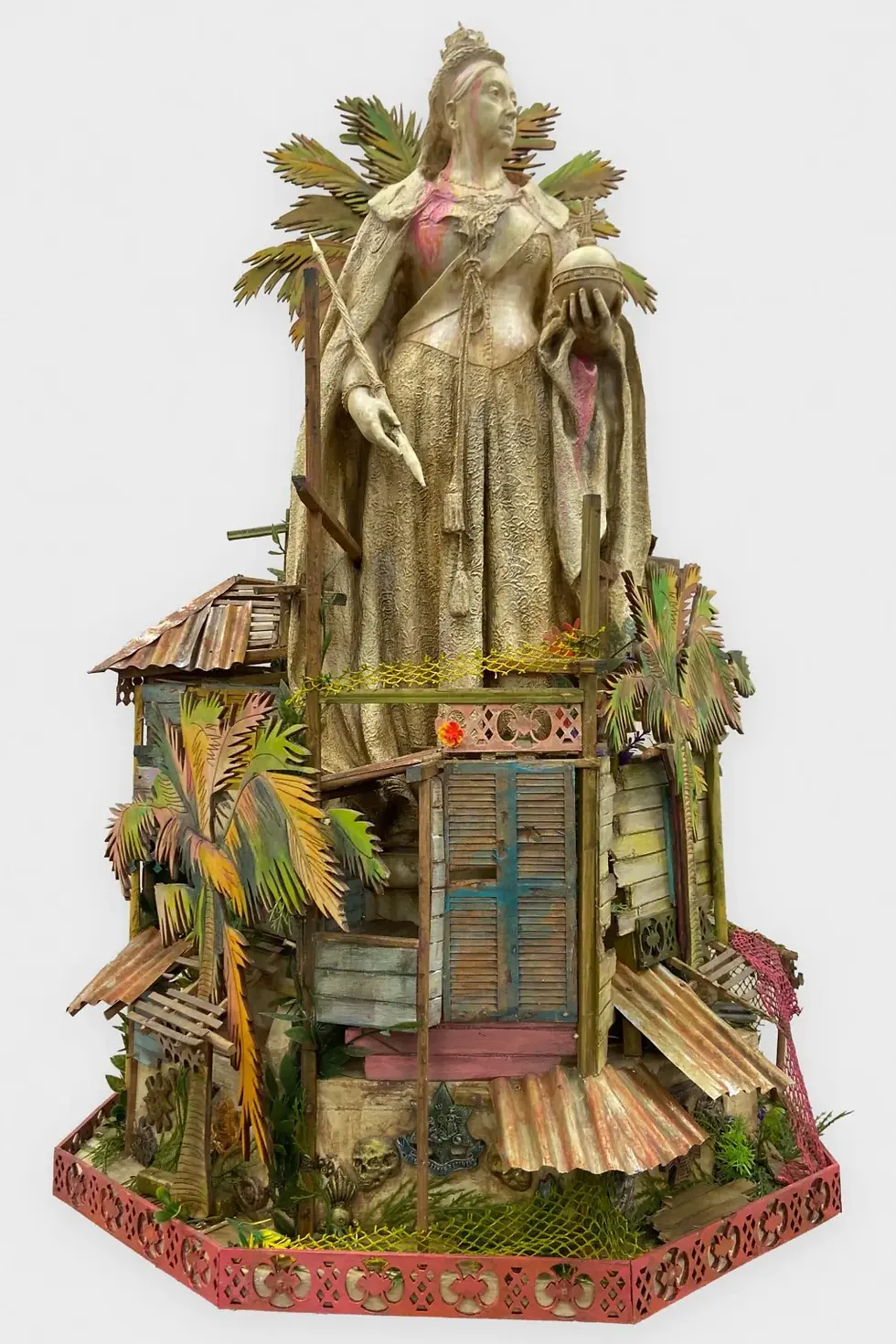
A new sculpture, Foreign Exchange 3, continues this examination of monuments and historical imagery. The work reimagines a statue of Queen Victoria within a landscape incorporating Caribbean vernacular architecture and tropical vegetation. It brings together references associated with British imperial history and the Caribbean within a single sculptural composition.
Two new watercolor series extend the exhibition into drawing. Knight Errant revisits the medieval and Arthurian imagery that formed part of Locke’s colonial education in Guyana, bringing the figure of the wandering knight into a Caribbean context. Spirit House focuses on Guyanese colonial timber houses, treating their architecture as a repository for memory and historical traces.

Locke also presents altered share certificates, transforming financial documents connected to colonial commerce into works concerned with finance, extraction and empire. The documents belong to the same material language that runs through the exhibition, in which familiar objects are modified and layered with new visual information.
Across The Wanderers, accumulation becomes a method. Historical objects, maritime imagery, financial documents, architectural references and decorative materials are brought together to create works that require attention to detail. Individual elements can be recognized, but their meanings change when placed alongside one another.
The title reflects one of the exhibition’s central concerns. The boats represent physical movement across oceans, while the other works consider the movement of people, money, objects and cultural imagery. Locke's interest is not limited to travel itself, but to what is carried between places and what remains attached to those journeys.
The exhibition also continues Locke’s examination of how history is represented. Ships, monuments, portraits and financial instruments can appear to be straightforward historical objects, but their meanings change according to where they are placed and how they are viewed. By altering and combining these references, Locke creates works that bring different histories into the same visual field.
The Wanderers brings these concerns together through sculpture, drawing and altered objects. Its boats, historical figures, architectural imagery and financial documents form a connected body of work in which movement, memory and the continuing presence of history are considered through material and visual form.
Exhibition: The Wanderers Artist: Hew Locke Venue: P·P·O·W Location: New York, USA Dates: September 9 – October 24, 2026
Artist website: Hew Locke