.png)


The Lost Royal Cuisine of Rampur | Nawabi Food History

How a small princely state in Uttar Pradesh built one of India's most refined cuisines, and then very nearly lost it

Roughly a hundred and fifty kilometres east of Delhi sits a town most people pass through without stopping. Rampur has no monument that draws crowds and no dish that has travelled the way biryani or rogan josh have travelled, and if you ask a reasonably well-fed Indian to name the great regional cuisines of the north, Rampur is unlikely to come up. This is a peculiar fate for a kitchen that was once considered the finest in the country and whose khansamas were regarded, in their time, as the most accomplished cooks in India.
The state was founded in 1774 by Rohilla Pathans, and for its first eighty years the food was more or less what you would expect from that lineage: heavy on meat, light on spice, largely grilled. What changed everything was a catastrophe elsewhere. When the revolt of 1857 broke out in Delhi and Lucknow, the courts that had sustained India's finest artists, musicians, poets and cooks collapsed with them, and the people who had served those courts scattered in search of patrons. Rampur, small but prosperous and still intact, took them in. Musicians came, and poets, and with them the khansamas of the Mughal and Awadhi kitchens, carrying techniques and recipes from establishments that no longer existed.
What happened next is the reason the cuisine is worth writing about. Rampur did not simply absorb these traditions. It became, in effect, a university for them. Cooks arrived from Mughal, Afghan, Lucknowi, Kashmiri and Awadhi backgrounds, and the Nawabs put them to work in a system that was rigid by design, in which a master of rice cooked only rice and a master of meat only meat, with each man responsible for a narrow domain he was expected to know completely. Nawab Sayed Hamid Ali Khan is recorded as having employed a hundred and fifty khansamas across three main kitchens.
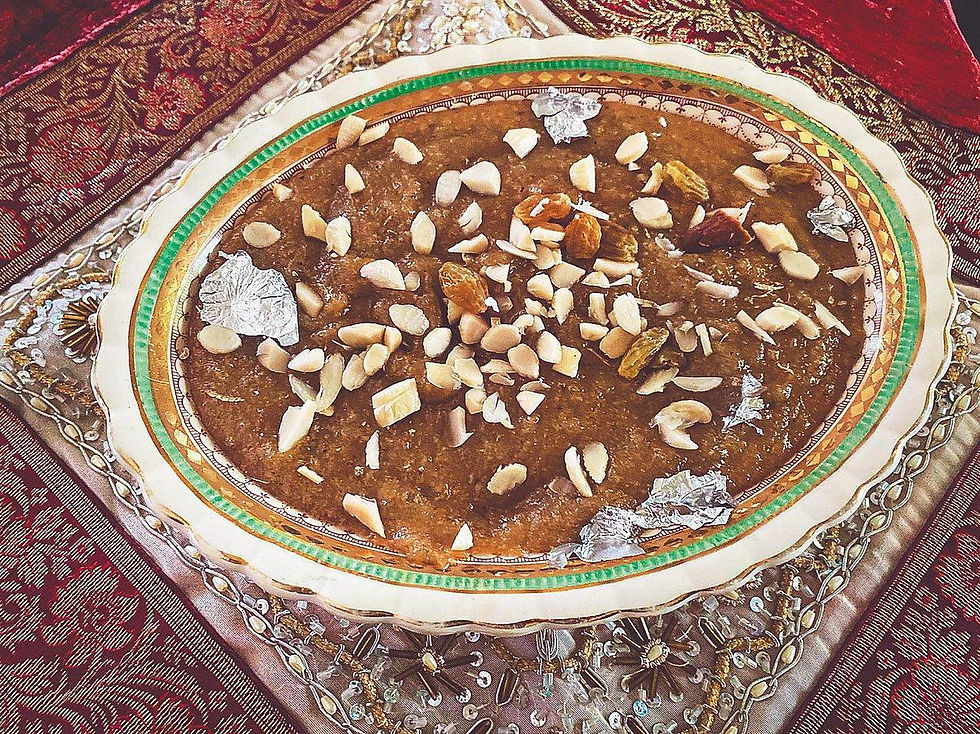
The rigidity might have produced nothing but competent repetition, except that the Nawabs kept pushing their cooks to trespass into one another's territories, and the collisions that followed produced the dishes Rampur is remembered for. A rice specialist working with sugar rather than meat gave the court mithi chawal. The kitchen developed a habit of unlikely sweets that has no real parallel anywhere else in Indian cooking, and halwas were made from ginger, from egg, from potato, from fish, from onion, and from green chilli. There is a sweet dish, mutanjan, built around meat.

The most repeated story in Rampur concerns the ginger. One of the Nawabs was prescribed a substantial daily dose of it for his health, disliked the taste intensely, and kept finding reasons to avoid taking it until the royal sweet-makers were instructed to solve the problem. What they produced was adrak ka halwa, which the Nawab is said to have asked for twice before anyone told him what was in it and which went on to become a signature of the court and to travel from there to Bhopal. Whether every detail of that account is exact hardly matters, since the dish exists and the logic of it, medicine reconstructed as luxury, tells you a great deal about how that kitchen thought.
The technical innovations were considerable and are not widely credited. The practice of tenderising meat with raw papaya and bottle gourd, now standard across Indian kitchens, is attributed to Rampur. So is the use of varq, the beaten silver and gold leaf that appears today on every celebratory sweet in the country, which the Rampuri court used where the Mughal kitchens had used a pastry parda to cover a dish. The do pyaza method, in which onions appear twice in a dish, browned and raw, to give both sweetness and sharpness, is widely believed to have come out of these kitchens.

The flavour profile that resulted is quite unlike its neighbours, and this is the part that ought to interest anyone who thinks they know North Indian food. Where Old Delhi is emphatic with spice, Hyderabad turns to sourness and Awadh to a certain perfumed sweetness, Rampur is built on ginger, on onion, and on a restrained combination of mace, nutmeg and khus root. The cooks used unrefined whole spices, cinnamon, sandalwood and yellow chilli among them, rather than ground ones, and cooked in clay. They reached for ingredients almost nobody else was using: lotus seeds, banana blossom, and the roots of khus grass. The result is food that is layered rather than loud, and the present Nawab has described a dish so carefully constructed that a guest would not know onions were in it at all, since it does not smell of them.
Some of this ambition was frankly theatrical. There is a family recollection of Nawab Raza Ali Khan seating his children and grandchildren before three desserts that looked identical, made from entirely different ingredients, and asking them to identify which was which. They were usually wrong.

And then the whole apparatus stopped. In 1949 Rampur became the first princely state to accede to the Indian Union, and while the last ruling Nawab kept a hundred dishes on the dastarkhwan at state banquets for as long as he could, the kitchen staff fell from a hundred cooks to thirty. What followed was slower and more final. The industries the Nawabs had built closed. The money to retain a hundred and fifty specialists was simply not there. The khansamas, who between them held an entire cuisine in their hands and almost none of it on paper, were let go, and they went looking for other work, and the recipes went with them.
The secrecy that had protected the cuisine now hastened its disappearance. These were not dishes anyone had published, because the court had no interest in seeing them published, and the present Nawab has been explicit that the family did not want the recipes made public. A cuisine held in the memory of employed specialists survives exactly as long as the employment does.
What has been recovered has been recovered slowly and mostly by one person. Tarana Husain Khan, a writer and cultural historian based in Rampur, came to the subject through a chance encounter with a nineteenth-century Persian cookbook in the Raza Library and has spent years since piecing the cuisine back together from manuscripts, memoirs, diaries and the recollections of the surviving khansamas and their descendants. Her book, Degh to Dastarkhwan: Qissas and Recipes from Rampur, published in 2022, is part memoir and part reconstruction, and it is the reason a good deal of this material is documented at all. The manuscripts she worked from include Nuskha Hai Ta'am, written by a nawab, and the last cookbook of the tradition, Shahi Dastarkhwan, published in 1948 by Latafat Ali Khan, a khansama from a family that had cooked for the court across generations.
The recovery has moved out of the archive and back to the stove. At an event in Delhi a few years ago, seventeen Rampuri dishes were translated from the historic texts and cooked by khansamas from Rampur, among them do-gosht pulao, seekh kabab nargisi, kundan qaliya, shabdegh, adrak halwa and gulathhi. There was a blind tasting of khichdi made from Tilak Chandan, a heritage rice variety nearly extinct in the region. Which is a fitting detail, since khichdi in Rampur was never the invalid's dish it is elsewhere in India, and there is a local saying that in winter it has more of a social life than pulao does.
There is a lesson in Rampur that goes beyond food, and it has to do with how fragile this kind of knowledge is. A cuisine that exists only in the trained hands of employed specialists disappears within a single generation of those specialists losing their work and leaves almost nothing behind because the thing itself was never written down and the people who knew it had no reason to think it would ever be needed in writing. Rampur came within a generation or two of vanishing entirely, and what is being cooked now is a reconstruction, assembled from manuscripts and memory by people determined not to let the rest of it go.


