.png)


360 ONE X Aisha Rao Presents Inter-Hana at Lakmē Fashion Week X FDCI


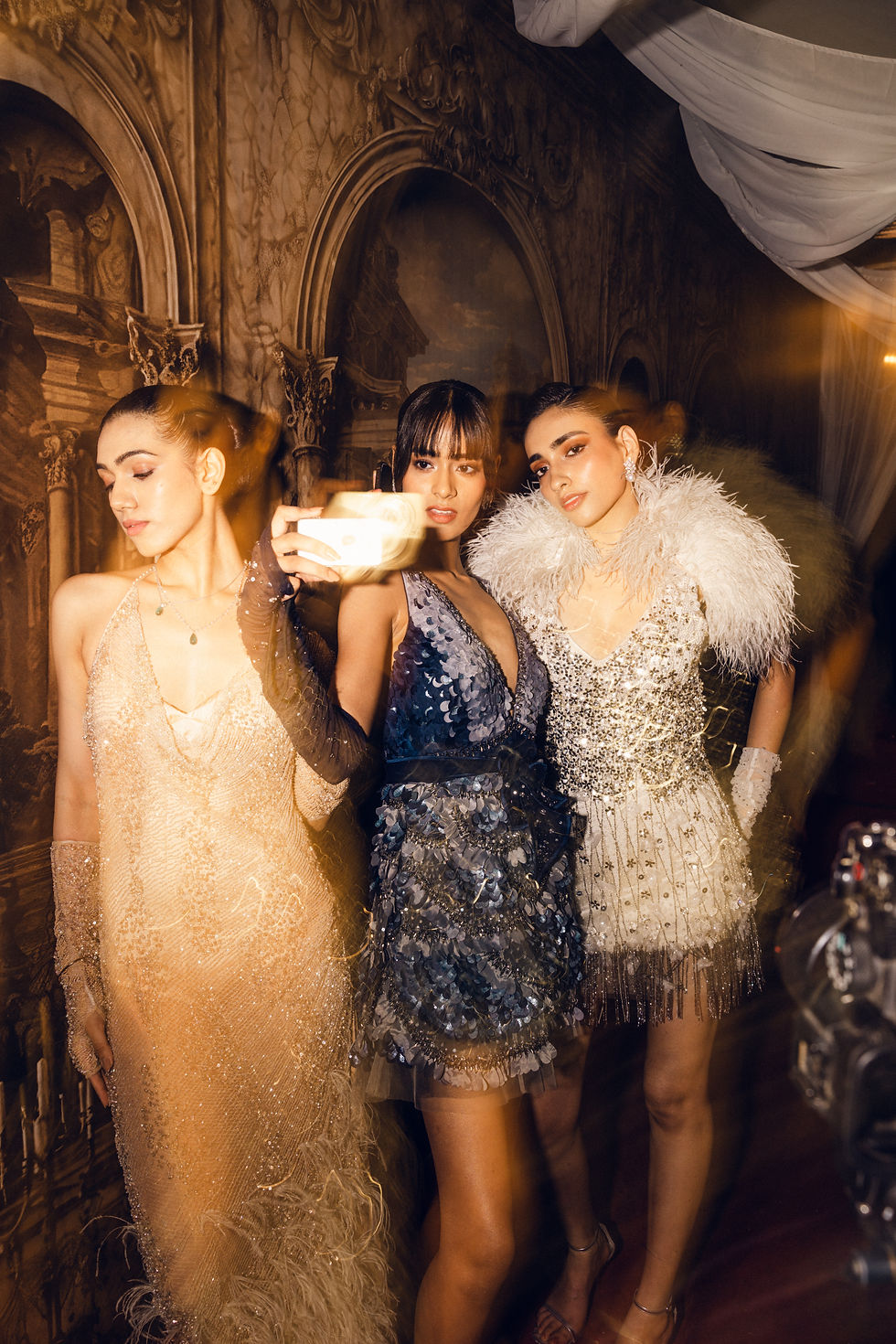
Aisha Rao showed her Spring Summer 2026 collection Inter-Hana on March 21st at Lakmē Fashion Week x FDCI in Mumbai, with 360 ONE as the presenting sponsor. The Hyderabad-based designer has built a consistent reputation for collections where the making process is as deliberate as the finished garment, and Inter-Hana continued that line of thinking with a collection rooted in cultural dialogue, in-house material development and a specific artistic reference that ran through every element of the presentation.
The title comes from two words: inter, meaning between, and hana, the Japanese word for flower. That in-betweenness is the actual subject of the collection. It occupies the space between gardens, between two significant chapters of personal experience, and between two distinct cultural vocabularies. The word inter also operates as a structural metaphor for the engineered mesh the label developed in-house at their atelier: a crochet-like interwoven surface that became both the collection's most distinctive material and its conceptual spine, standing for cultural dialogue, structural interdependence and the continuity of craft.

The artistic departure point was the work of Japanese artist Fumi Imamura, whose floral compositions reinterpret botanical folklore from Japan's Aichi region. Imamura's philosophy that feelings are expressed through the shapes of flowers she creates gave Rao a framework to work within rather than a reference to replicate. Through her own design sensibility, Rao translated Imamura's minimalist floral language into something with considerably more textural density and colour richness. Leaves shifted into paisleys. Florals unfolded into geometric interpretations. The conversation between Japanese restraint and Indian maximalism was never resolved into a single unified aesthetic but held as a productive tension throughout the collection, which is precisely what gives Inter-Hana its character.
Fabric development was entirely in-house, which at Aisha Rao is not a marketing claim but a design methodology. The engineered mesh that names the collection was constructed from scratch. Lace-like borders were built with precision rather than sourced. Layers of organza and tulle were worked at varying degrees of translucence to create depth within individual garments. Scrunched lurex introduced stretch and flexibility, allowing pieces to move with the body rather than against it. The commitment to material development at the source means that the surface of every garment in this collection carries a degree of specificity that off-the-shelf fabric cannot produce, and it shows on the runway.

Silhouettes reflected the balance between structure and movement that defines the label's approach. Corsetry was softened through drape so that it gave shape without restricting. Ballooned hems were supported with architectural shaping underneath. Skirts moved between body-skimming and fluid forms depending on the fabrication. Separates were designed with the kind of versatility that allows a piece to move from a daytime context into an evening one without requiring a change in the garment itself. The range of silhouettes across the collection felt cohesive rather than scattered, which is a harder thing to achieve when the brief is as conceptually layered as this one.
Surface detailing completed the visual story. Raffia accents, handcrafted trims and tactile embellishments echoed the textures within the garments, creating a cohesive design language that ran from the fabric construction through to the finishing. Abstract motifs drawn from Imamura's floral compositions appeared in embellishment as well as in print, giving the collection a visual consistency across different garment types and silhouettes.

The colour palette reflected the dual cultural reference of the collection. The quieter, more restrained tones associated with Japanese minimalism appeared alongside the richer, more saturated colours that run through Rao's body of work, and the two sat together without either cancelling the other out. The palette felt considered and specific rather than arrived at by mood board.
Bollywood actor Khushi Kapoor closed the show as showstopper, wearing a shimmering floral-embellished crop top paired with a coordinated lehenga, an ensemble that brought together several of the collection's surface languages into a single closing statement.
Aisha Rao founded her label in 2018 in Hyderabad, building it around a signature appliqué technique in which fabric is cut, layered and reconstructed into bold graphic motifs combined with intricate hand embroidery. The method began as a response to studio waste and evolved into the label's defining aesthetic. The brand now operates five independent stores across India, with three in New Delhi at The Dhan Mill Chhatarpur, Ambawatta One Mehrauli and DLF Emporio Vasant Kunj, one in Mumbai at Kala Ghoda and one in Hyderabad at Banjara Hills.
Inter-Hana is a collection that knows what it is about and builds everything around that. The cultural reference is specific, the material development is genuine, and the silhouettes carry the concept without being consumed by it. For a designer who has consistently positioned craft as the centre of her practice, this season felt like a further deepening of that commitment rather than a departure from it.
Lakmē Fashion Week x FDCI continues in Mumbai.
You May Also Like