.png)


Ananya Birla's Met Gala 2026 Look: Subodh Gupta Mask Decoded

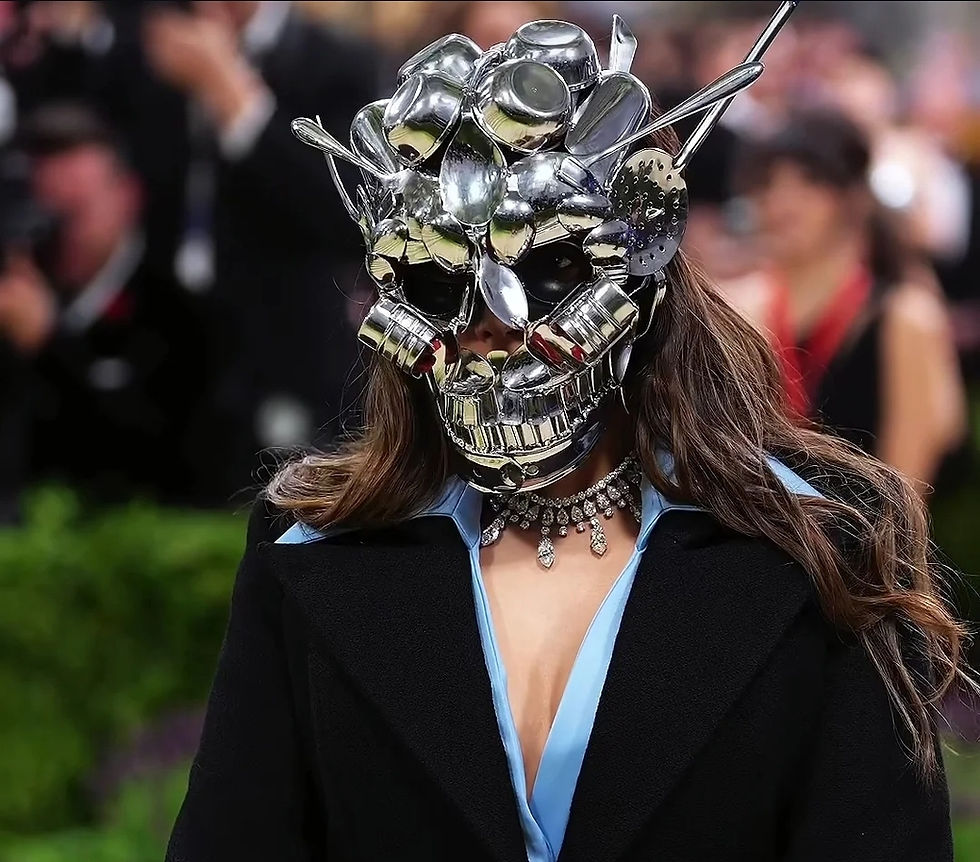
Inside the most talked-about debut of Met Gala 2026, where Indian artist, a Hong Kong designer, and a Birla heiress turned steel katoris and slotted spoons into the night's defining image.
When Ananya Birla climbed the steps of the Metropolitan Museum of Art on the evening of May 5, 2026, she did so without a visible face. No red lip, no defined cheekbone, no artfully highlighted nose catching the flashbulbs. What the cameras found instead was a construction of mirror-polished stainless steel kitchen utensils welded into a fitted sculpture that covered her entirely from hairline to jaw, leaving only her eyes open to the world. In a night that had Beyoncé, Rihanna and Nicole Kidman all working the same carpet, it was this image, two dark eyes behind a mask of Indian serving spoons and steel katoris, that the internet decided to keep. It was also, on close inspection, one of the most carefully considered looks the Met Gala has seen in years.
The Artist: Why Subodh Gupta Was the Only Person Who Could Have Made This
Subodh Gupta was born in Khagaul, Bihar, and grew up in precisely the kind of household whose objects would go on to define his entire artistic practice. He trained as a painter before moving into sculpture, and when he arrived at his mature language as an artist, it turned out to be made of the same stainless steel that surrounded him growing up: tiffin boxes, lotas, katoris, pressure cookers, the steel vessels of Indian domestic life that move through the most intimate and significant moments of a family's existence without ever being considered worthy of serious attention.
His career has been built on a single sustained argument, that these objects carry within them a weight of cultural and emotional significance that the Western art world had spent decades failing to recognise, not because that significance was absent but because the objects themselves had never been placed anywhere that demanded it. Gupta placed them in the Tate Modern, the Centre Pompidou and the Guggenheim, building them into large-scale sculptures that confronted audiences with material they had no existing framework for and forcing those audiences to slowly develop one. His work Line of Control, which stacked thousands of steel kitchen vessels into a form that simultaneously evoked a towering Indian kitchen shelf and the shape of a nuclear mushroom cloud, became one of the most discussed sculptural works of its generation precisely because of how completely and casually it collapsed the distance between the domestic and the monumental, between the object you use every morning and the object that makes you stop in a gallery and feel something you cannot immediately name.
At Met Gala 2026, working in collaboration with designer Robert Wun and stylist Rhea Kapoor under the dress code Fashion Is Art, Gupta brought that same collapse to its most direct and personal expression yet, transferring his entire artistic vocabulary onto a single human face and sending it up the most photographed staircase in fashion.

Inside the Mask: Every Object, Every Detail, and Every Decision
The base of the mask is acrylic, custom-molded to fit Ananya Birla's facial structure precisely so that the weight of the steel surface above it is distributed safely and evenly across her face, making it possible to wear the piece across a full evening without discomfort. This interior framework is completely invisible in photographs and was never intended to be seen, but it is what separates the mask from being a purely sculptural object and makes it genuinely wearable. Everything the camera sees is steel, and every piece of that steel is a real kitchen utensil sourced from the same domestic context Gupta's work has always drawn from.
Looking at the mask closely in high-resolution photographs, the inventory of objects that make up its surface becomes legible in considerable detail. The forehead and upper section are built from multiple small katoris, the round steel bowls that sit in virtually every Indian kitchen and are used daily for everything from dal to curd, arranged with some placed upright and others inverted so that their curved dome surfaces cluster together into a unified mass forming the crown of the piece. From this upper section, the handles of spoons and ladles extend outward and upward at varying angles, giving the mask from a distance its distinctive silhouette, a sculptural halo of steel handles that reads almost like a crown when the piece is photographed straight on. Moving down through the mid-section of the mask, spoons of varying sizes are laid overlapping across the nose and cheekbone areas, their bowl-ends facing outward to create the reflective surface of the central face, and on the right side a slotted serving spoon with its distinctive perforated pattern is clearly identifiable, sitting flush against the surface and integrated fully into the surrounding construction. Around the cheek and jaw area, small steel tumblers and short cylindrical vessels of the kind used across Indian households for water and chai are placed horizontally and stacked against each other, their tubular forms providing the structural volume of the lower face, and the mouth area is composed of a tight row of these same cylindrical elements arranged so closely together that when a camera flash hits them directly they create a line of reflected light that reads, almost eerily, like a set of teeth.
Once every utensil was assembled, arranged and welded into its final position, the entire surface was polished to a mirror finish, and this is the decision that makes the mask behave so unusually across the thousands of photographs taken of it that evening. Mirror-polished stainless steel does not simply reflect light the way sequined fabric or metallic paint does. It picks up the complete visual environment surrounding it and compresses that environment into its curved surface, meaning that every photograph of this mask is simultaneously a photograph of wherever Ananya happened to be standing at that moment, the green foliage of the museum steps, the blue of the event backdrop, the flash of another camera firing nearby, the warm overhead lighting, all of it absorbed into the steel and returned outward in concentrated, distorted form. The consequence of this across the vast archive of images taken that night is that the mask looks genuinely different in every single photograph, sometimes blazing white with reflected flash, sometimes a deep cool silver, sometimes catching the blue of the backdrop and reading almost electric, not because the object itself changed between frames but because its mirror surface was faithfully recording a different environment each time the shutter fired.
The only opening in the mask is a horizontal band across the eye area, with the entire rest of the face sealed completely behind steel. Because the eyes are the only human element remaining in a composition built entirely from kitchen utensils, every viewer who looks at any photograph of this mask eventually arrives at them, drawn there not by conventional beauty logic but by the simple and powerful fact that they are the only living thing in an otherwise entirely industrial surface, and that contrast, two eyes looking out from behind a slotted serving spoon and a row of steel tumblers, gives the mask an emotional pull that is genuinely difficult to look away from.
The Robert Wun Gown: The Same Argument Made in Fabric
Robert Wun built a custom couture piece for Ananya that shares the mask's conceptual logic so completely that the two function as a single unified work rather than a garment and an accessory that happen to exist alongside each other on the same person. Wun, whose work is consistently defined by silhouettes that carry an emotional and almost cinematic charge, took the codes of everyday workwear for this collaboration and extended them into their most extreme formal expression, applying the same principle that governs the mask to the clothing beneath it, which is that the ordinary, when pushed far enough, becomes something else entirely.
The bodice is a structured blazer in a silk, wool and cotton blend, cinched at the waist with tight precision tailoring and flaring into a wide dramatic peplum before giving way to the skirt, and its construction is deliberately architectural and stiff in a way that gives the upper body a silhouette closer to armor than to conventional formal dressing. Beneath it, a light blue collared shirt is visible at the chest and neckline, its collar sitting open, and this detail, which reads at first glance as a simple layering choice, is one of the most deliberate elements in the entire look, the ordinary office shirt worn by millions of working people every morning tucked inside a Met Gala couture construction as a quiet and direct reminder of where the look draws its references and its meaning from. The skirt is floor-length, voluminous and heavily pleated, made from gunmetal glass organza, a semi-metallic fabric that shifts and catches light as the wearer moves and creates a constant visual contrast against the rigid stillness of the blazer above it, so that the overall silhouette reads as simultaneously hard and fluid, structured above and liquid below, which is its own form of the same tension the mask creates between industrial material and human presence.
Styling by Rhea Kapoor
Rhea Kapoor's decisions on this look were defined almost entirely by a discipline that is harder to execute than it sounds, because the natural instinct when dressing someone for the Met Gala is to add, and the entire logic of this look required the opposite. A mask of this complexity and visual presence demands that everything surrounding it step back far enough that the sculpture can breathe and the viewer can see it clearly, and Kapoor built the rest of the look around that requirement without making a single compromise.
Jewelry was reduced to a diamond choker from Mehta and Sons layered with some of Ananya's own personal pieces, which provided enough shimmer to register under camera lights without introducing any visual element that might compete with or distract from the steel construction above. The hair was left loose and straight, falling over the shoulders without any volume or styling intervention that might crowd the mask or create a competing shape against it. Makeup artist Loveleen Ramchandani gave Ananya luminous, clean, polished skin beneath the mask, skin that surfaces only through the exposed eye area and makes those eyes, already the emotional center of the entire composition, as sharp and present as possible. Hair was managed by Marissa Marino with the same philosophy of elegant absence that runs through every other decision in the look. The official portraits were photographed by Rafael Pavarotti for L52 Communications, and his images are the ones that circulated most widely that evening, because he understood precisely how to give the mask the light it needed and produced photographs that sit much closer to gallery documentation than to standard red carpet imagery, which given what Ananya was wearing is entirely the right register.
What the Look Is Saying
Ananya Birla arrived at her first Met Gala as someone who needed nothing from the event in terms of validation or visibility. She is the daughter of Kumar Mangalam Birla, the chairman of one of India's largest industrial conglomerates, a recording artist with over 500 million global streams, a mental health advocate who co-founded Mpower alongside her mother Neerja Birla, and since March 2026 a co-owner of Royal Challengers Bengaluru following her family group's landmark 1.78 billion dollar acquisition of the franchise. Any gown from any designer in the world would have earned her coverage that night, and a beautiful, safe, impeccably made look would have placed her on every best-dressed list without asking anything difficult of anyone in the room.
Instead she walked onto the carpet wearing the steel katori from an Indian kitchen on her face, made by an artist from Bihar who has spent the better part of three decades insisting that these objects deserve to be properly seen and properly valued. The collaboration between Gupta, Wun and Kapoor, which carries the title crafting the Ordinary into the Extraordinary, is not simply a description of the aesthetic approach taken on the night. It is the entire point of the exercise, the argument the look is making and the reason it continues to circulate long after the carpet has closed. The slotted serving spoon sitting against Ananya Birla's cheekbone at the Met Gala 2026 is the same object sitting in a kitchen drawer in millions of Indian homes right now, picked up without thought and put back without notice, and Subodh Gupta spent his entire career arguing that it was always worth looking at properly. On the steps of the Metropolitan Museum of Art, on the night of May 5, 2026, in front of every camera fashion has to offer, he proved it.
Credits: Mask: Subodh Gupta / Couture: Robert Wun / Stylist: Rhea Kapoor / Jewellery: Mehta and Sons / Makeup: Loveleen Ramchandani / Hair: Marissa Marino / Photography: Rafael Pavarotti, L52 Communications
You May Also Like
Gwendoline Christie Met Gala 2026: The Giles Deacon Gown, the Gillian Wearing Mask and the Question of Who We Are When We Cover Our Faces Beyoncé at Met Gala 2026: The Crystal Skeleton, the Headpiece and the Feathered Train That Took Several People to Carry Diya Mehta Jatia Met Gala 2026: The Mayyur Girotra Gown That Brought Bengal's Nearly Extinct Shola Craft to the World's Most Watched Red Carpet


