.png)


Celia Sawyer: The British Designer Who Turns Private Jets Into Palaces That Feel Like Home

Updated: Apr 24

In an exclusive conversation with Shweta for Design Diary International, Celia Sawyer speaks about designing for objects in motion, the discipline behind the glamour, and why true luxury has nothing to do with noise.
She left school at fifteen in Bournemouth with almost no qualifications and a certainty that she was not going to spend her life being told what she could not do. She worked as a dental nurse. She tried modelling, briefly and by her own admission unsuccessfully. She became a photographer's agent, placing talent with advertising agencies including Saatchi and Saatchi, because she had always been drawn to things that were beautiful and to the business of making them visible. Then she bought a property in London, refurbished it, added a floor, and people came to see what she had done and asked her to do the same to their homes. That was the beginning.
Twenty years later, Celia Sawyer's Mayfair studio is one of the most sought after luxury interior design practices in the world. She has designed for Saudi Arabian royalty, for global celebrities, for sporting icons, for entrepreneurs whose names she will never disclose because discretion is among the services she provides. She designed the warrant officer's mess on HMS Queen Elizabeth for the Royal Navy in 2017. She has been named one of the top ten interior designers in the world, listed in the Top 100 Most Influential British Entrepreneurs, named among the Top 250 Most Powerful Women Leaders, and won the Inspiration Award for Women in 2013. She is an Ambassador for the British Heart Foundation and the Prince's Trust, a patron for Women's Refuge, and a mentor for the British Library.
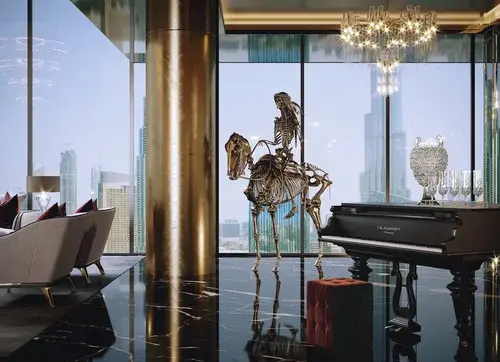
British television found her when Channel 4's Four Rooms cast her as one of its four dealers, a role she held across five series and which earned the show a Royal Television Society Award in 2014. The BBC then gave her her own prime-time show, Your Home in Their Hands, which debuted in 2014 and drew over three million viewers a week. She did all of this while simultaneously running a global design practice that operates at a level most designers spend their entire careers trying to reach.
Her portfolio spans luxury residences across London, Barbados, Hollywood, New York and the Emirates, private superyachts, helicopter interiors, and some of the most extraordinary privately owned aircraft ever commissioned. She is one of the most remarkable self-made figures in British design, and she built everything from nothing.
What Sawyer has built operates in territory most designers never enter, where aesthetic intelligence must be accompanied by a fluency in the particular psychology of people who have access to everything and therefore require something more considered than the merely expensive. Designing for air and sea, she explains, is fundamentally different from designing a home on land. You have to think in terms of engineering, physics, and weight distribution, but also in terms of emotion. It is about creating a sanctuary that feels still, even when it is moving at 600 miles an hour.

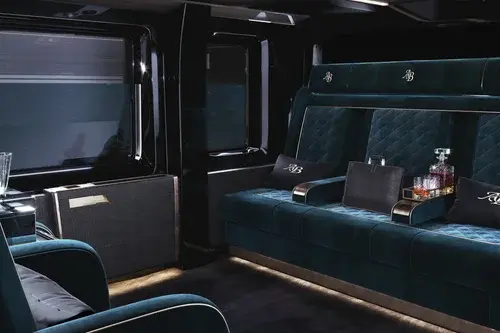
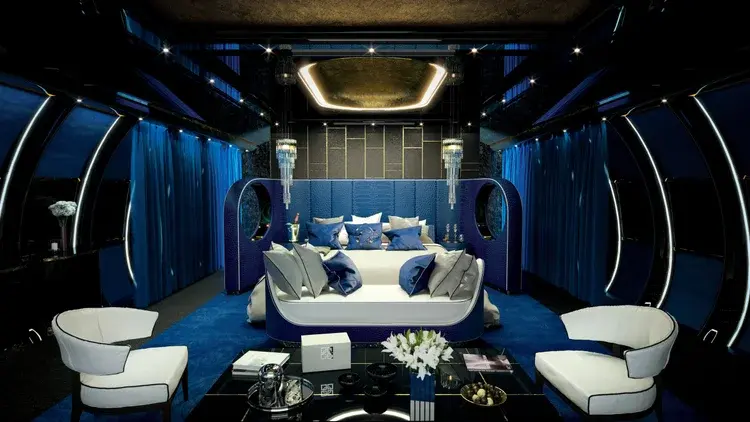
One of her most celebrated commissions came from a Middle Eastern royal who asked her to transform a privately owned Airbus A340 into what he called a residence in the sky. The master suite was built around deep blue tones, with a king-sized bed framed by a hand-stitched crocodile leather headboard and flanked by bespoke hanging crystal fixtures, each one engineered specifically to remain perfectly still during flight. Gold and crystal ran through the aircraft's interiors like a continuous language. The main bathroom featured a Swarovski crystal and glass washbasin. The adjoining bath was sculpted from midnight-blue marble and fitted with an integrated mirror-faced television. In the salon and lounge, Sawyer traced the aircraft's natural curves with individual gold-plated ceiling sections that visually widened the space, balanced by linear seating in hand-stitched Tuscan leather, silk and velvet arranged in the majlis tradition to create intimacy within grandeur. Two crystal chandeliers with gold accents illuminated a bar that glowed softly from beneath. It was, by any measure, a palace in motion.

She describes the discipline this kind of work demands with a precision that reveals exactly why her clients trust her with commissions of this scale. Designing a jet or yacht, she says, is like composing music under rules. You cannot rely on excess. Every curve, every line, every material has to earn its place. When you get it right, it feels effortless. On water the same principles apply differently. Her yacht interiors move with the rhythm of the sea itself, curved cabinetry mirroring the horizon, champagne tones rippling across silk and polished wood, light shifting as the tide shifts beneath the hull. The light is never still, she says. You design not only for how something looks but how it moves with the water.
Her starting point, regardless of whether the project flies, sails, or stands still, is never visual. When she walks into a project, she does not think about what she sees. She thinks about how it should make someone feel. That feeling becomes the foundation for everything. Her interiors are cinematic but not theatrical, spaces where light and reflection and texture have been choreographed to produce a specific emotional experience rather than a specific impression. She thinks of them as film scenes. Even in the most compact and technically regulated environments, the goal is to move the person inside them.
Every commission involving aircraft or marine vessels demands close work with engineers and technical specialists to ensure the design meets safety and performance standards at every point. Working within the laws of nature, she says, is not a limitation but the place where the challenge becomes inspiring. The discipline imposed by physics and regulation forces a precision of decision-making that, when handled correctly, produces results that feel inevitable rather than labored.
Her clients know almost nothing about each other because Sawyer has built her practice on discretion as a founding principle. Royalty, global leaders, creative icons, sporting personalities, entrepreneurs whose projects span continents — she names none of them. Privacy is everything, she says. Her clients' trust is sacred. Success does not need to be loud. It can live quietly in the confidence of your work.
That quietness extends into her definition of luxury itself, which has evolved considerably from the industry's traditional preoccupation with rarity and expense. True luxury, as she now understands and practices it, is calm. It is comfort, silence, beauty without noise. Technology hidden beneath texture. Lighting that feels organic rather than designed. Materials that breathe rather than announce themselves. Too many statement pieces compete with one another, she observes. One beautiful focal point lets the space breathe. The meaning of luxury, she says plainly, is no longer about rarity. It is about emotional luxury. It is about how a space understands you.
The pivotal moment in her career came early, with a private jet commission that reframed everything she thought she was doing. That was when she realized she was not designing spaces. She was designing experiences. She was designing emotion. It is a distinction she has never lost sight of since, and it explains why her work reads as consistently and recognizably hers across environments as different as a superyacht salon and a London townhouse. Even in the largest spaces, she starts with intimacy. She thinks about how someone will sit, how the light will fall, how they will feel. Design, she says, should always begin with the human experience.
Her understanding of beauty has shifted in parallel with her practice. Beauty used to be about perfection. Now it is about harmony, authenticity, balance. Nature, she says, always shows you how it is done. Whoever said you cannot mix green and blue has never looked at the sky meeting the trees. Her clients, wherever they are from, share one quality she recognizes immediately upon meeting them. People of taste recognize authenticity instantly. They value things made with intent, things that have meaning. And the intention behind every commission she accepts is the same. She wants her work to last, not just physically but emotionally. Luxury, she says, should endure, not fade.
You May Also Like


