.png)


Isha Ambani Met Gala 2026: The Gold Sari, the Nizam's Jewelry, and the 1,800-Carat Blouse Built From Her Mother's Collection

Updated: May 10

Every detail of Isha Ambani's Met Gala 2026 look, from the gold-woven Gaurav Gupta sari painted by a National Award-winning Pichwai master to the 1,800-carat blouse envisioned by Nita Ambani and built from the family's jewelry archive, the Nizam's sarpech, and the bronze mango by Subodh Gupta, the only artist whose work appeared on two separate Met Gala looks on the same night.
Isha Ambani has attended the Met Gala six times. She has worn Anamika Khanna, Rahul Mishra, and some of the most complex Indian couture taken to that carpet in recent memory. In 2025 she arrived in a diamond necklace featuring 89 stones totaling 481.42 carats that reportedly took 15,000 hours to complete. Each appearance has been a deliberate statement about Indian craft and design on a global stage, and each has been more specific and more layered than the one before it.
In 2026 she wore a sari. Not a sculptural sari gown of the kind she has worn before. A traditionally draped sari, the oldest living garment in the world, on the steps of the Metropolitan Museum of Art for the first time in six appearances. "There is no garment more deserving of that space than the sari," she said. "It is timeless and inherently elegant, and despite its deep-rooted tradition, it continues to feel endlessly relevant in the modern world."
The decision to wear a traditionally draped sari rather than a reconstructed version of one was the first and most significant creative choice of the entire look. Everything else followed from it.
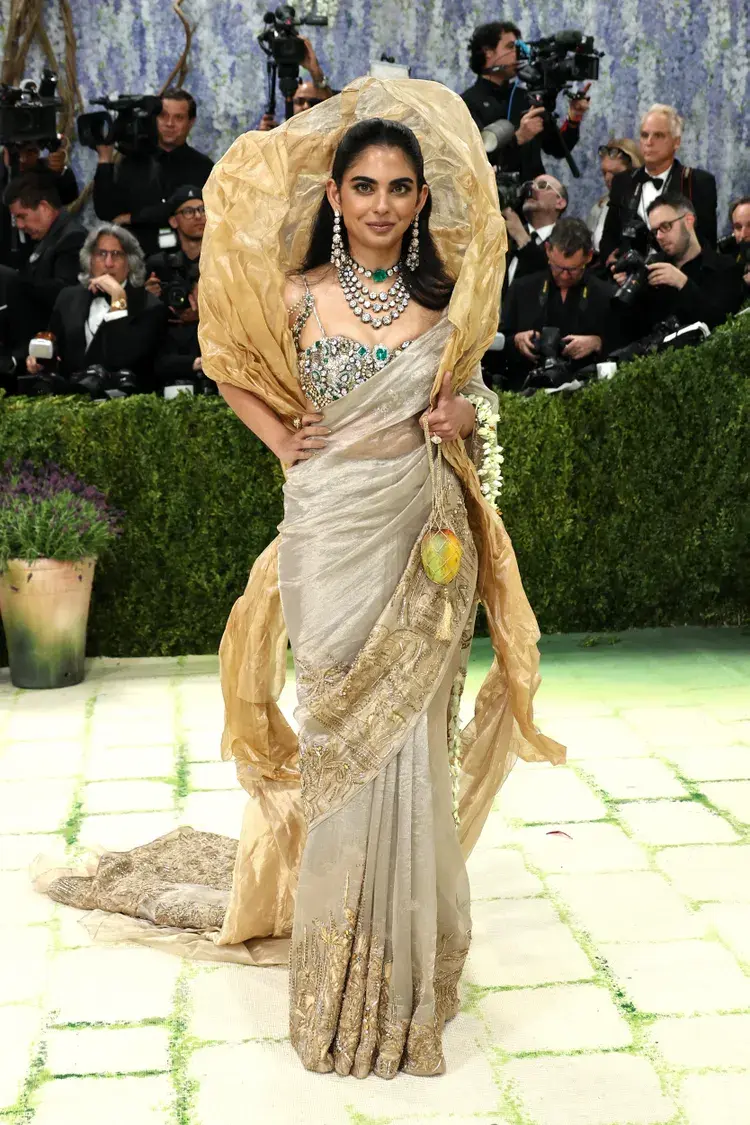
The Sari: Gold Thread, Pichwai Painting and the Ajanta Caves
The sari was designed by Gaurav Gupta in collaboration with Swadesh, Reliance Retail's artisan-only platform dedicated to preserving India's craft heritage, and it required more than 1,200 hours and over 50 artisans across the complete look to bring to completion. The fabric is hand-woven tissue silk with threads of real gold running through its entire surface—not metallic yarn or gold-toned thread, but actual gold, woven into the silk by master weavers from the Swadesh collective.

The border of the sari carries hand-painted Pichwai-inspired motifs in soft gold and earthy tones, drawn from the visual language of the Ajanta cave murals, among the oldest surviving examples of Indian painting and a touchstone of the country's artistic heritage. These were not printed or embroidered. They were hand-painted directly onto the woven surface by National Award-winning Pichwai art master Trilok Soni and his team, who were flown to Gaurav Gupta's atelier in Delhi specifically for this commission and spent more than 150 hours applying the painted motifs to the fabric. Over those painted surfaces, three layers of hand embroidery were then applied in sequence: zardozi, the metal wire embroidery technique that builds raised three-dimensional surfaces; aari work, a fine hook-based embroidery technique that creates dense flowing lines of thread; and relief embroidery, which lifts selected elements off the fabric plane and into physical depth. By the time all three layers were complete, the sari border had become something closer to a painting than a textile, its surface carrying painted imagery, raised metal forms, and dimensional thread work simultaneously.

For Gupta, the sari as a garment carried specific meaning within the context of the Met Gala 2026 theme. "Here we wanted to go back and celebrate one of the oldest living costumes of the world," he said, "which has survived not just centuries, but millennia." The stylist Anaita Shroff Adajania, one of India's most internationally recognized stylists, described this as a departure for both the designer and the wearer. "This look marked Isha's first time wearing a traditional sari at the Met," she said, "and for Gaurav a departure from his usual couture language."
The Cape: A Second Sari Sculpted Into a Halo
Alongside the hand-painted tissue silk sari, a second Banarasi tissue sari was commissioned and transformed into the architectural cape that gives the look its dramatic silhouette. Gupta sculpted it using his signature in-house resin draping technique, which allows fabric to hold a three-dimensional form rather than simply falling under its own weight. The resulting cape frames Ambani's neck and trails behind her alongside the pallu, the long trailing end of the draped sari, creating what Gupta described as a halo-like structure around the upper body. "We wanted to add that drama for the Met stage," he said. The cape is not an addition to the look. It is structurally part of it, a second sari given a completely different life through the resin process, so that the two fabrics, one traditionally draped and one sculpted, exist in conversation with each other.
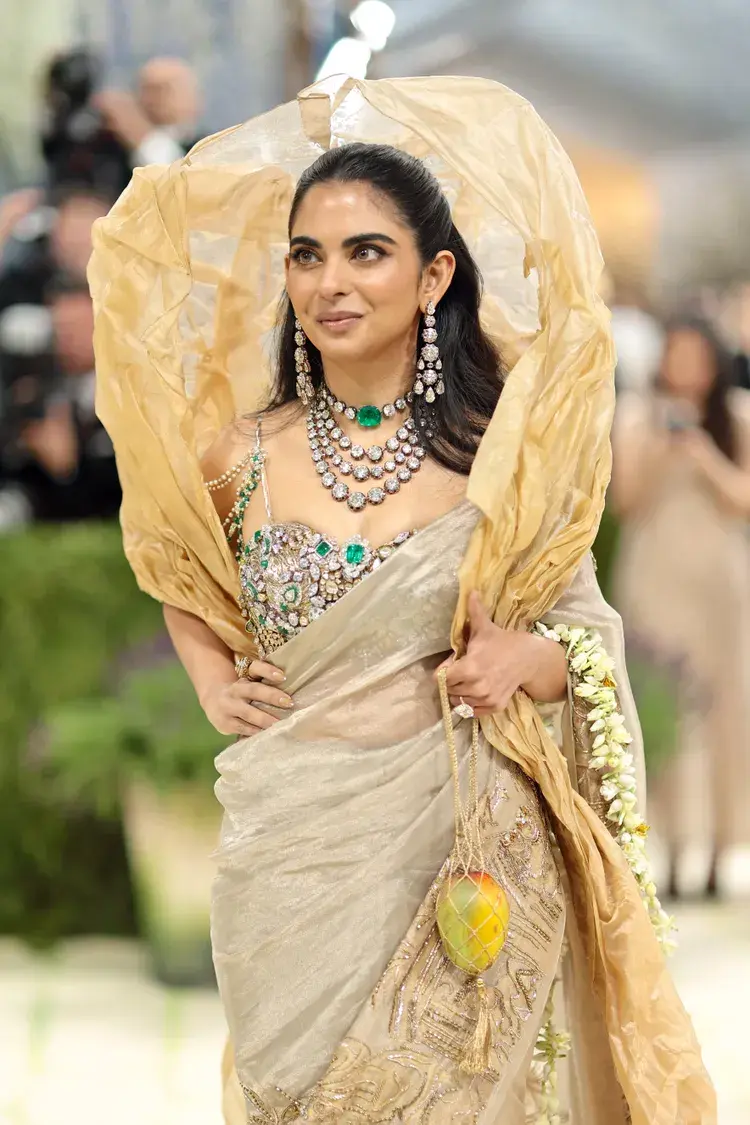
The Blouse: Nita Ambani's Vision, Kantilal Chhotalal's Craft, 1,800 Carats of Family History
The blouse is where the look moves into territory that has no real precedent in Met Gala history. It was not conceived in a designer's studio. The blouse was envisioned by Nita Ambani herself and created by the legendary Indian jeweler Kantilal Chhotalal in close collaboration with Anaita Shroff Adajania, constructed on tulle and lined with brocade at the Ambani residence in Mumbai, where Gaurav Gupta's embroiderers worked directly alongside the family's jewelers to break down actual heirloom pieces from the family's archive and re-set those stones into the fabric of the bodice itself.

More than 1,000 stones totalling over 1,800 carats were embedded into the blouse using zardozi anchoring and hand-tucking: old mine-cut diamonds, polki which are uncut diamonds set in gold, kundan which is the traditional Indian technique of setting gemstones in pure gold foil without prongs, emeralds and pearls, drawn almost entirely from the Ambani family's private jewelry archive. Isha said on the red carpet, "It's a hand-woven sari, and the blouse is full of my mother's jewelry." She went further in describing what those pieces mean. The accessories incorporated into the look, she said, are all different sentimental pieces, including a gift she received when her children were born alongside other objects that carry personal history. Gaurav Gupta described the result in a statement: "Over 1,800 carats of diamonds, alongside emeralds, polki and kundan, are embedded into the garment, transforming it into a living surface of inheritance and form."
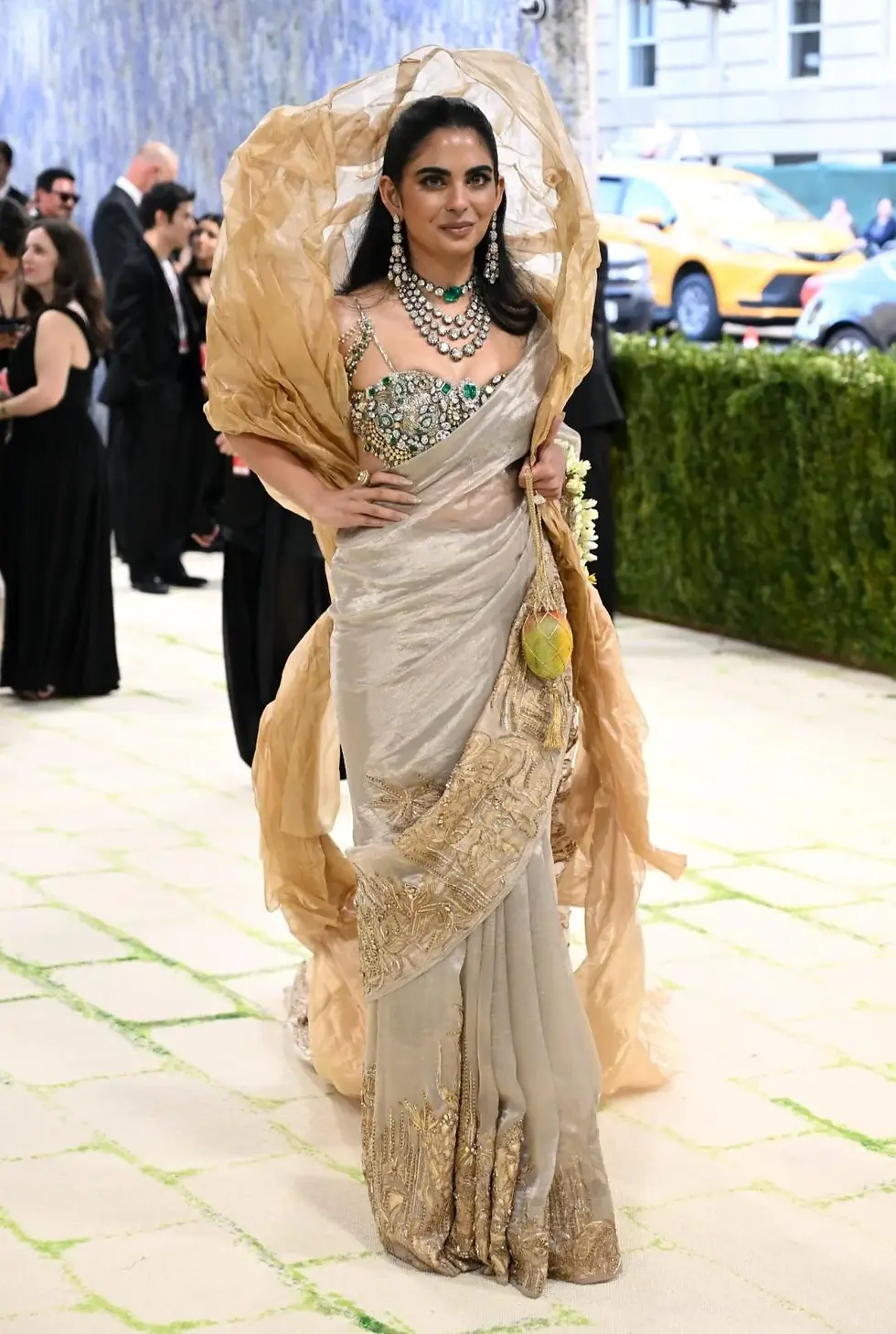
At the center of the back of the blouse sits the single most historically significant element in the entire look: a sarpech from the Nizam of Hyderabad's jewelry collection, belonging to Nita Ambani. A sarpech is an ornamental plume traditionally worn at the front of a royal turban and associated in India with the highest levels of Mughal and princely court regalia. The Nizam of Hyderabad was for decades considered the wealthiest man in the world, and his jewelry collection is among the most documented and celebrated in the history of Indian royal adornment. The sarpech Isha wore is set on its visible face with rose-cut and table-cut diamonds set using kundan and finished with antique emerald bead drops. The reverse of the sarpech, not visible in photographs, carries meenakari, the ancient Indian enamel work applied to the hidden side of the piece as the final mark of its royal origin. It was placed not at the front of the body as a sarpech would traditionally be worn but at the center of the back of the blouse, positioned so that it would be revealed when the sari drape moved, a piece of Mughal court history turned into the quiet surprise of a contemporary Met Gala garment.
The Ambani women's history of remixing royal Indian jewelry into contemporary fashion contexts has its own precedent within the family. Nita Ambani once transformed Shah Jahan's Kalgi, a Mughal feather ornament of the same tradition as a sarpech, into an armlet. Placing the Nizam's sarpech at the back of a Met Gala blouse is entirely consistent with that approach, taking objects of royal and historical significance out of their original context and finding them new ones.

The Jewelry: Layers, Haathphools and a 50-Carat Emerald
The jewelry was not assembled as a collection of individual pieces chosen for visual effect. Adajania described it as falling in layered drapes that reflect a distinctly Indian sensibility of adornment, rich, cascading, and inherently expressive, with each stone carrying its own past, its warmth and scale preserved rather than refined away. Together, she said, the pieces form a seamless dialogue between past and present, where Indian craftsmanship meets enduring materials like diamonds, emeralds, pearls, and gold, resulting in a language that feels both timeless and quietly modern.
Two graduated diamond necklaces together totalling over 250 carats sit at the neck, one of them anchored by a 50-carat emerald sourced from Lorraine Schwartz, both from Nita Ambani's personal collection and featuring old mine-cut diamonds accumulated over decades. Haathphools, the traditional Indian hand jewelry that extends across the back of the palm and fingers in a single connected piece, extend across Isha's hands. Diamond waist belts trace the fall of the sari at the hip. The overall effect is not of jewelry placed on a body but of a body that has been adorned in the full traditional Indian sense, from the neck to the waist to the hands, each element connected to the others by the same visual and cultural language of layered inheritance.

The Mango: Subodh Gupta, Aam Aadmi and One Artist on Two Looks
The bag Isha Ambani carried to the Met Gala 2026 was a 3.10 by Guggi bag. Inside it sat a bronze mango sculpture by Subodh Gupta, weighing approximately 800 grams, cast from bronze by Gupta's own foundry after European foundries he initially approached turned down the commission because they did not know what a mango looked like. Gupta eventually had it cast in India with Indian craftspeople for whom the mango required no reference material whatsoever. "I love to play with the words," he said about the piece, "mango and aam aadmi." Aam aadmi in Hindi means the common person, the ordinary person, the person for whom the mango is not a luxury or a symbol but simply the fruit that has always been there. A bronze mango weighing 800 grams carried inside a bag on the steps of the Metropolitan Museum of Art is that argument made in the most visible way possible.
The mango sculpture was made over two decades ago and found renewed global attention on this evening. What makes its presence at the Met Gala 2026 particularly significant is that Subodh Gupta was the only artist at the event with his actual artwork present on two separate guests simultaneously. Ananya Birla, whose Met Gala debut Style Essentials covered in full, wore a face mask built entirely from stainless steel kitchen utensils made by Gupta. One look wore his work on her face. The other carried it in her hand. The two pieces could not be more different in scale, material, or form, yet they make the same argument in different registers: the most ordinary objects in Indian life have always been art. They were simply waiting for the right stage.

The Hair Sculpture: 150 Hours of Paper, Copper and Brass
The hair accessory Isha wore is a sculptural reinterpretation of the gajra, the traditional string of fresh jasmine flowers Indian women wear in their hair at celebrations. It was created by Brooklyn-based artist Sourabh Gupta, who spent 150 hours handmaking each individual element from paper, copper, and brass, painting them with Indian pigments to produce an interpretation of the mogra paranda, the traditional ornamental hair accessory that incorporates jasmine as its central motif. Each jasmine bud and bloom was individually hand-shaped and painted before being assembled into the finished piece. Placed in Ambani's hair for the evening, it occupied the same conceptual territory as the rest of the look: a traditional Indian object rendered in unexpected materials, elevated through craft into something that belongs in a gallery while remaining entirely legible as something worn.
What She Said
"Wearing a sari on the Met steps for the first time, especially this handwoven piece, fills me with immense pride," Ambani said. "It feels like carrying a piece of India's heritage on an iconic global stage." She described her choice of Gaurav Gupta as a natural fit for a theme centered on fashion as art. "His work exists at the intersection of sculpture and fluidity. He has a truly unique way of reimagining form while honoring essence."
Gupta reached for a reference that placed the sari within the longest possible historical frame. "In India, adornment itself has always been elevated to art," he said, citing the Solah Shringar, the sixteen traditional steps of adornment rooted in ancient Indian traditions that represent beauty, prosperity, and divine feminine grace. The sari, the embroidered blouse, the layered necklaces, the sarpech, the jasmine sculpture in the hair, and the mango in the hand: taken together, they are not separate styling decisions assembled for a red carpet. They are sixteen steps, each one specific and each one carrying its own history.
Credits: Sari: Gaurav Gupta in collaboration with Swadesh / Pichwai Painting: Trilok Soni and team / Stylist: Anaita Shroff Adajania / Blouse: Envisioned by Nita Ambani, created by Kantilal Chhotalal in collaboration with Anaita Shroff Adajania / Jewellery: Nita Ambani personal collection / Hair Sculpture: Sourabh Gupta / Mango Sculpture: Subodh Gupta / Bag: 3.10 by Guggi / Image Courtesy: Isha Ambani Instagram
You May Also Like
Gwendoline Christie Met Gala 2026: The Giles Deacon Gown, the Gillian Wearing Mask and the Question of Who We Are When We Cover Our Faces Beyoncé at Met Gala 2026: The Crystal Skeleton, the Headpiece and the Feathered Train That Took Several People to Carry Diya Mehta Jatia Met Gala 2026: The Mayyur Girotra Gown That Brought Bengal's Nearly Extinct Shola Craft to the World's Most Watched Red Carpet


