.png)


Gwendoline Christie Met Gala 2026: The Giles Deacon Gown, the Gillian Wearing Mask and the Question of Who We Are When We Cover Our Faces

Updated: May 10

For her third Met Gala, Gwendoline Christie wore a red gown by her partner, carried a mask of her own face made by a Turner Prize-winning artist, and asked the most interesting question of the entire evening: Is it a shield or is it an expression?
Gwendoline Christie, best known globally for playing Brienne of Tarth in HBO's Game of Thrones, has been thinking about masks for a long time. She has been thinking about height, femininity, the versions of ourselves we perform for the world, and the gap between the face we show and the one we feel we have. When the Met Gala 2026 invitation arrived with the theme Fashion Is Art, Gwendoline Christie reconnected with her desire to hide and designed an entire look around that feeling.
The result was one of the most quietly radical things on the carpet that evening. A red Giles Deacon gown. A Stephen Jones headpiece. And in her hand, a mask of her own face, made by British Turner Prize-winning artist Gillian Wearing, was held up in front of her real face for the photographers while her actual features disappeared behind it. Two faces on the same woman on the same carpet, and the question of which one was more real was left entirely open.
The Gown: Three Artists Inside One Dress
The gown is Giles Deacon, which for Christie carries a weight beyond the purely sartorial. She and Deacon have been partners for over a decade, and she had wanted to wear his work to the Met Gala for thirteen years before this evening made it possible. "I've wanted to wear Giles for the Met Gala since before I was even in a relationship with Giles," she said in one of the interviews she gave around the event. "So this has been a long time coming."
Deacon built a red gown with a sculpted bodice and a flared feather-trimmed tulle hem, its silhouette referencing theatrical costume traditions rather than conventional red carpet dressing. The gown's rich red, exaggerated proportions, and feather-trimmed hem firmly establish its theatrical character, fitting for an actress of Christie's stature. The gown is not fashion pretending to be art. It is fashion that understands it is already performance.

Three artists provided the creative references Deacon and Christie worked from to build the look. John Singer Sargent, the American expatriate painter whose portraits defined a particular kind of formal grandeur in the late 19th and early 20th centuries, inspired the cinched waist and mermaid silhouette, the way the gown holds the body tightly before releasing into the flared skirt. Ira Cohen, the New York poet and photographer, was a third creative reference within the look's overall artistic framework. And Madame Yevonde, the British surrealist photographer who worked in the 1930s and whose vivid hand-colored portraits challenged the conventions of both portraiture and femininity, provided the most personal reference of all.
Christie recently discovered she is related to Yevonde, and at the National Portrait Gallery she came across a Yevonde photograph called Mask, showing a woman named Rosemary Chance holding a painted mask in front of her face. She described the effect in one of the interviews she gave around the event as surreal, delicate, and technicolor, and it stayed with her. It became the seed of everything that followed. "I kept thinking about how I wanted to wear a mask to shield me from my vulnerabilities," she said in one of the interviews she gave around the event, "how I use them in my own work to realize my inner world, and then Giles said, What about a mask by Gillian?"

The Headpiece: Stephen Jones
The Stephen Jones headpiece adds vertical structure to the look, its feathers extending upward and outward from the head in a way that frames Christie's face without competing with the mask she carries below it. Jones, one of Britain's most celebrated milliners, built the piece to sit within the theatrical register of the gown, its drama calibrated to the scale of Christie's 6-foot-3 frame. The custom Herbert Levine shoes, designed by stylist Katie Grand specifically for this look, complete the silhouette at ground level.
The Mask: Gillian Wearing and the Question of Identity
The mask is where the look moves from extraordinary dressing into the territory of genuine art, and it requires understanding who Gillian Wearing is to fully appreciate what she made.
Wearing is one of Britain's most significant contemporary artists. She won the Turner Prize in 1997, and her practice across three decades has been consistently focused on the instability of identity, on the gap between how we present ourselves and who we actually are, on confession and concealment and the versions of the self that social performance both enables and suppresses. In 1994 she made a video work in which people confessed their most private thoughts while wearing masks, the masks freeing them from the weight of being seen. In 2000 she made the first mask of her own face. In 2017 she made a photograph called Through Mask and Mirror, in which she wore a mask of her own face while holding a hand mirror frame through which the mask extended, creating an image that collapsed the distinction between reflection and disguise.
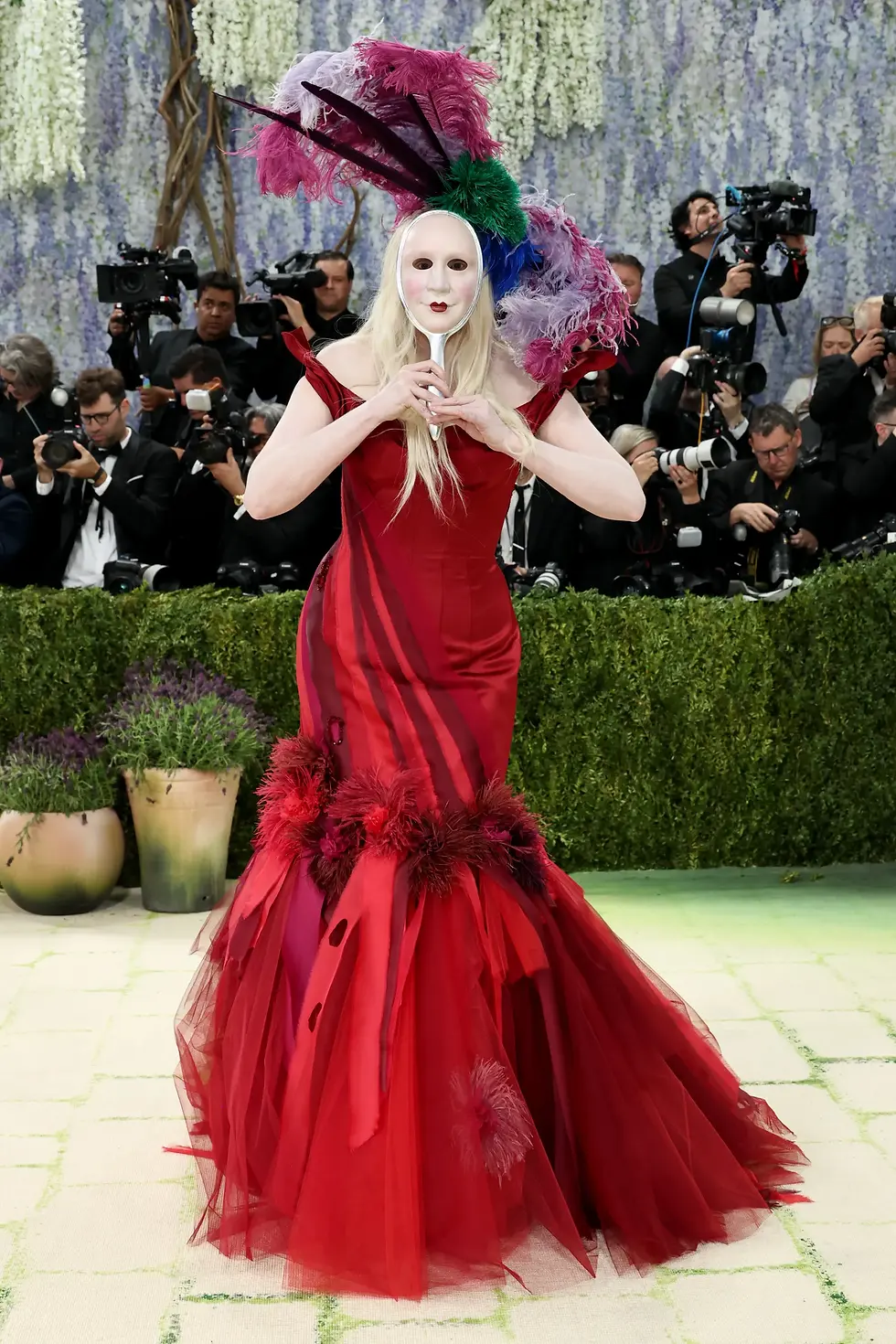
That 2017 work is what Christie approached her about recreating for the Met Gala. Christie contacted Wearing through mutual friends and described the request as asking for the impossible. Wearing said yes immediately. The mask was physically constructed by Mark Stirling at Applied Arts, the same studio that built Wearing's original self-portrait mask in 2000, and it was made from a cast of Christie's actual face.
Wearing's description of the conceptual logic behind the piece is the clearest articulation of what the mask is actually doing. "I wanted to have the mirror frame molded around the mask of Gwendoline's face, the mask replacing the reflecting component, blending the physical and symbolic roles of both the mirror and the mask," she said in one of the interviews given around the event. "Mirrors reflect who we are, but by merging it with the mask, it suggests that identity is not simply something we reflect; it is also one of transformation, and that identity is much more layered. Can we ever reflect ourselves, as we are always editing, creating, and evolving identity? We are many, many selves."
She continued in the same interviews given around the event: "For a great actress like Gwendoline, that relationship is much more pronounced, but it is something that so many people who are not professional performers are engaging with in the digital age, as faces can be reshaped, filtered, and reimagined. The lines between our physical selves and digital appearances blur and likely change our self-perception.
Christie's own account of what she wanted to express through the mask is more personal than any intellectual framing of the concept. "I expressed to Gillian how I wanted to hide, to display a smoother version of my own self, the face perhaps I wished I had, the masks we all wear, the duality of our feelings at this time in the world, and how we survive," she said in one of the interviews she gave around the event. She referenced the Rainbow Portrait of Elizabeth I, the famous painting in which the queen's dress is embedded with messages about power, stealth, and surveillance; and the Mask of Youth, the very pale cosmetically painted face that historical records suggest was slowly toxic to its wearers. The duality of the mirror and the mask, she said, excited her. "Am I shielding or reflecting the world?"

She then described something that gives the mask its deepest personal dimension. "Because I've always been so conscious of my height, I've always been consciously feminized," she has said in interviews over the years. "I used to spend Friday night with my mother's makeup, and I'd practice becoming something other than myself." The mask of her own face, held in front of her own face on the most photographed carpet in fashion, is not an abstract conceptual exercise. It is a woman who has spent her life negotiating with her own image, making that negotiation visible and handing it to a Turner Prize-winning artist to render physical.
The Conversation This Look Is Part Of
Gwendoline Christie was not the only person at Met Gala 2026 who covered her face. Ananya Birla arrived the same evening wearing a Subodh Gupta sculpture made from Indian kitchen utensils that sealed her entire face behind polished steel, leaving only her eyes visible. Two masks on the same carpet on the same night, both deliberate, both conceptually grounded, and both asking versions of the same question about identity and concealment, one through the language of Indian contemporary art and one through the practice of a British Turner Prize winner whose career has been built on exactly this territory.
Neither look was coordinated with the other. Two completely separate creative processes arrived at the same essential question on the same evening. Christie held her mask in her hand and posed with it and behind it and through it. Birla sealed her face completely and let only her eyes speak. The question each was asking was identical. What remains of a person when you remove or replace their face? And which version, the face or the mask, is the more honest one?
Credits: Gown: Giles Deacon / Headpiece: Stephen Jones / Mask: Gillian Wearing, physically made by Mark Stirling at Applied Arts / Shoes: Herbert Levine custom designed by Katie Grand / Stylist: Katie Grand / Hair: Adir Abergel / Makeup: Jenna Kuchera for Pat McGrath / Skin: Joanna Vargas / Image Courtesy: Gwendoline Christie Instagram / Giles Deacon Instagram
You May Also Like
Gwendoline Christie Met Gala 2026: The Giles Deacon Gown, the Gillian Wearing Mask and the Question of Who We Are When We Cover Our Faces Beyoncé at Met Gala 2026: The Crystal Skeleton, the Headpiece and the Feathered Train That Took Several People to Carry Diya Mehta Jatia Met Gala 2026: The Mayyur Girotra Gown That Brought Bengal's Nearly Extinct Shola Craft to the World's Most Watched Red Carpet


