.png)


Resting Pavilion, Osaka Expo 2025: MIDW Turns Excavation Into Architecture

Updated: Apr 14

Fact File
Project: Resting Pavilion, Osaka Expo 2025
Location: Yumeshima, Osaka, Japan
Area: 248 m²
Architects: MIDW
Structure: Jun Yanagimuro Structure Design, Toshiaki Kimura
Furniture: Studio arche
Year: 2025
Photography: Benjamin Hosking
Yumeshima, the artificial island hosting Expo 2025 in Osaka, sits on reclaimed land with inherently weak ground conditions. Any construction on the site required the removal of a volume of soil equivalent to the weight of the proposed building before work could begin. For most projects, such an undertaking would be an inconvenient prerequisite to be resolved and forgotten. For MIDW, it became the design.
The entire site was excavated into a sequence of alternating hollows and mounds, an operation that simultaneously fulfilled the soil removal requirement and generated a rhythmic, undulating topography across the ground plane. The excavated terrain was then used directly as formwork: a roof was cast using the contoured earth surface as its mold, lifted, rotated ninety degrees on the plan, and placed back onto the ground. The result is a continuous cave-like void between the undulating ground surface and the raised roof above it, a spatial condition that reads from the images as simultaneously open and sheltered, structural and geological.
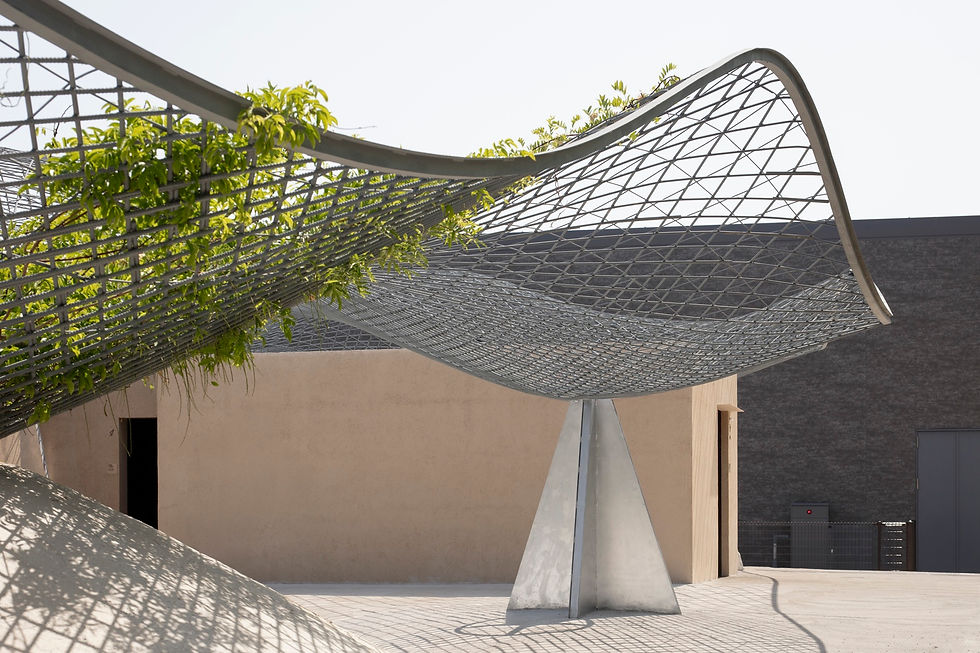
The images make the formal quality of this operation legible in a way that a description alone cannot. Looking across the pavilion from ground level, the roof is a large-format mesh structure, its triangulated grid curving and dipping in a fluid form that bears the imprint of the terrain from which it was cast. The mesh reads as light and almost transparent against the sky, its grid casting a patterned shadow across the pale ground surface below. A single tapered concrete or steel column supports the structure at one point, its pyramidal form making the most direct structural statement in an otherwise deliberately ambiguous composition. The ground itself rolls in soft waves beneath the roof, with a low curved bench set into one of the hollows, and the tree canopy of the adjacent landscape is visible through and above the mesh on all sides.
Wisteria has been planted on the mounds, climbing upward over the rising roof surface and beginning to establish itself across the mesh grid. As the plants grow, they cast shade on the ground below while building a new ecosystem within and around the structure. The relationship between the planted vegetation and the built mesh is visible in the images: green growth is already threading through the steel grid at the upper edges, blurring the boundary between the constructed and the natural.

MIDW has framed the project with a specific long-term intention. If the pavilion is retained after the Expo rather than demolished, the structure would gradually become overgrown, the wisteria and adjacent forest eventually absorbing the built form into the landscape. The pavilion's current state, visible in these photographs, is an early point in what the architects envision as a longer process of transformation, from temporary installation toward something closer to ruin and rewilding.
The project is a direct response to the specific conditions of its site: the weak ground, the soil removal requirement, the reclaimed island context, and the temporary nature of the Expo program. Each of these constraints is addressed by the same operation: excavating the terrain, which generates the topography, produces the formwork, creates the spatial experience, and sets the conditions for the vegetation that will define the structure's future. It is a project where the problem and the solution are the same act.
You May Also Like