.png)


Manish Malhotra Wore His Entire Career to the Met Gala 2026. It Took 960 Hours and 50 Artisans to Build It.
- Style Essentials Edit Team

- May 6
- 7 min read
Updated: May 10

The designer who spent 35 years dressing India finally stepped into the spotlight himself, and he brought every person who made that possible with him.
Manish Malhotra has dressed Bollywood royalty, Hollywood names, actual royalty, and some of the most photographed women in the world. For 35 years he has been the person standing behind the camera, behind the fitting room door, behind the star on the red carpet. At Met Gala 2026, for the first time on fashion's biggest stage, he stepped in front. And he did not arrive alone. He arrived with 50 artisans on his back, the city of Mumbai in his embroidery, and the names of the people who built his career written directly into the fabric.
The look took 960 hours and the collective labor of more than 50 artisans across Mumbai and Delhi to complete. It is the most personal garment he has ever worn publicly, and looking at it closely, panel by panel, it is also one of the most layered and specific pieces of wearable storytelling the Met Gala carpet has seen in years.

The Foundation: A Black Bandhgala
The base of the look is a classic black bandhgala, the formal Indian jacket that has been a constant in Malhotra's design vocabulary for decades. It is smooth, unembellished, structured, and deliberately quiet, a foundation that tells you everything is happening on the cape layered over it. The bandhgala has one exception to its restraint: the left cuff is embroidered with the words Mumbai City of Dreams in a decorative bordered cartouche, a detail so precisely placed that it reads almost like an official stamp, the designer's declaration of origin pressed directly into the fabric of his own clothing. The inner collar of the bandhgala carries a label that also reads Mumbai City of Dreams, a private acknowledgement that becomes visible only when the cape opens from behind.

The Cape: A City Embroidered Onto Black Velvet
The cape is structured, architectural, and falls dramatically from the shoulders to nearly the floor, its edges dissolving into long white fringe that hangs in heavy curtains from the hem and cascades downward with every step. The base fabric is black velvet, and against it, in white-on-black embroidery using dori, zardozi, chikankari and kasab techniques layered together, Malhotra has built a visual map of the city and the career that city made possible.
The embroidery does not read as pattern or decoration. It reads as a city. The Bandra-Worli Sea Link, Mumbai's iconic cable-stayed bridge with its distinctive triangular pylons and fanning cables, is rendered on the cape in precise threadwork, the cables reproduced strand by strand in white dori against the black velvet. Mumbai's modern skyline rises beside it, the glass towers and high-rises of a contemporary city drawn in clean embroidered lines. The Taj Mahal Palace Hotel, one of Mumbai's most recognizable heritage landmarks with its distinctive domed roof and colonnade windows, appears on another section of the cape, its elaborate facade rendered in careful white threadwork. A vehicle is embroidered into the lower sections, a reference to the streets of the city that surrounds all of these landmarks. Floral elements and organic forms weave between the architectural references throughout, softening the urban density of the imagery with botanical relief.

On the right lapel of the cape, a tailor's measuring tape is embroidered running vertically from collar toward the hem, its measurement numbers clearly legible in white thread, the numbers 8 through 16 visible in sequence. It is the single most telling detail in the entire garment, a designer's most fundamental tool rendered in the craft he has spent 35 years mastering, the instrument of measurement placed on the garment itself as both reference and signature. Beside it, a vintage film camera is embroidered, a direct acknowledgement of the Bollywood world that made Malhotra's name and gave Indian fashion its largest global platform. A sewing machine appears in the lower sections of the cape, unmistakably rendered, the machine that sits at the heart of every atelier and that makes every garment possible.
The back of the cape, when it opens as Malhotra moves, reveals itself as what appears to be a map, with line work tracing roads, boundaries and locality outlines across the full surface of the black velvet. On the back panels, names appear written into the embroidery in both Latin and Devanagari script: Anwar, Riyasat Ali, Ajay Das, Kamruddin, and others alongside them. These are not decorative text elements, they are the names of the artisans who built the cape, written into the fabric of the garment itself so that the people who made it are permanently part of it, present in every photograph taken of this cape at every event at which it will ever appear.

The center back carries a large, fully dimensional chikankari floral composition, delicate flowers and leaves worked in raised white thread against the black velvet, the only section of the cape that steps entirely away from the urban and cinematic references and into the purely botanical, a breathing space within the density of the rest of the surface.
The 3D Figurines: The Artisans Made Monumental
What separates this cape from extraordinary embroidery and places it into the category of wearable sculpture is the three-dimensional figurines positioned across its surface. Rendered in white resin, sculpted with enough detail that individual facial features, clothing folds and body postures are clearly readable, these figures are representations of the artisans from Malhotra's atelier, placed on the cape so that they are physically and literally present on the red carpet alongside the designer.
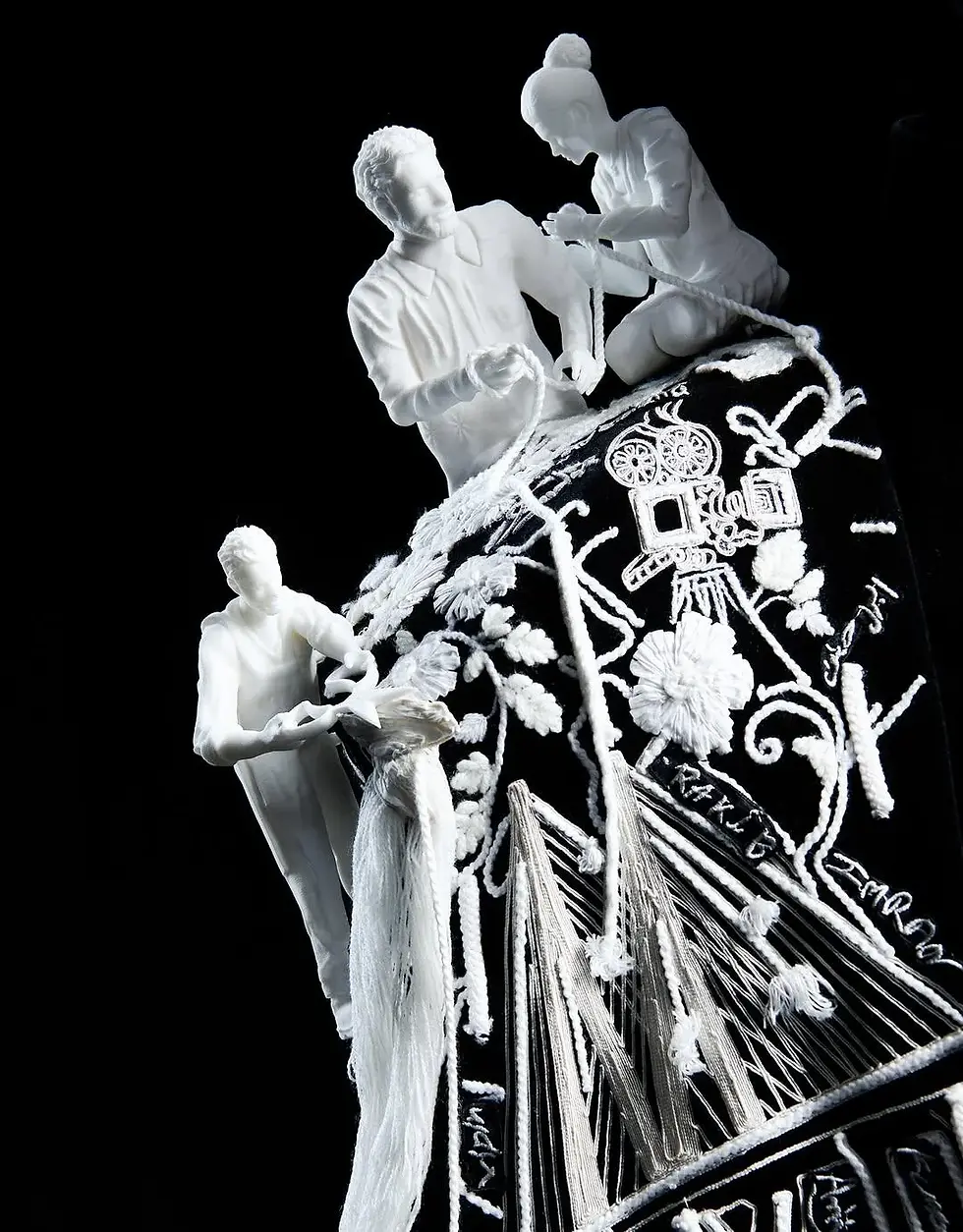
On the left shoulder of the cape, a man leans forward in a dynamic pose, his body angled and his arms extended in the act of physical craft work, pulling thread or working material with the kind of full-body effort that hours of hand embroidery actually requires. On the right shoulder and along the cape's lapels, other figures are positioned in complementary poses: a woman in a graceful stance, a figure in a dynamic upward-reaching posture, figures seated and bent over their work. One of the most detailed figurine groupings shows three or four figures gathered together around what is clearly an open sketchbook showing design drawings, a representation of the collaborative process of translating a designer's vision into a finished garment that is recognizable to anyone who has ever worked in an atelier.
These figurines are not static decorations placed symmetrically for visual effect. They are positioned in active relationship to the embroidery around them, the figures in dynamic poses reaching toward the architectural elements of the Mumbai skyline, the working figures surrounded by the names written into the fabric below them, so that the cape reads as a living scene rather than a static surface, the artisans embedded within the city that produced them, working within the landscape that shaped the career they collectively built.

The Atelier and the Man inside It
One image from the making of this garment captures the entire concept of the look more completely than any red carpet photograph could. It was taken inside Malhotra's atelier before the Met Gala, and it shows him standing in the full cape while his team of artisans, more than fifty men dressed in white, seated at sewing machines and workbenches and standing in rows around him, all look directly into the camera. The unfinished fringe threads of the cape extend outward from the garment across the workbenches, still connected to the hands and the machines that produced them. Malhotra stands at the center of his atelier in the garment his team built, surrounded by the people whose names are written into its fabric and whose likenesses are sculpted onto its surface, and in that frame the entire concept of the look becomes completely legible. This is not a designer wearing a tribute to his artisans. This is a designer wearing his atelier, carrying it with him to the Met Gala, refusing to separate the finished garment from the hands and the room and the people that made it possible.

What He Said
Malhotra posted on his own social media with the caption: Fashion is Art / Artisan. Our atelier at The Met. The order of those words was deliberate. Art first, then artisan, then the declaration that the atelier itself, not just the designer, had arrived at the Metropolitan Museum of Art. "This look is both a celebration and a reminder of where we come from, and how Indian craftsmanship continues to find its place on a global stage," he said. "When I heard fashion is art, the first word that came to my mind was artisans. It was the right place to give credit to the people who work behind all of it."
In his 35th year in the business, the designer who has given countless stars their most iconic moments chose to use his own Met Gala appearance not to showcase his design range or his celebrity connections or his expanding global footprint, but to make the people behind those things visible in the most permanent and public way he could. He wrote their names into the velvet. He made their likenesses in resin and placed them on the cape. He walked them up the steps of the Metropolitan Museum of Art and stood in the photographs that will record this night for as long as fashion keeps records.
Credits: Look: Manish Malhotra / Jewellery: Manish Malhotra High Jewellery / Image Courtesy: Manish Malhotra Instagram
You May Also Like
Gwendoline Christie Met Gala 2026: The Giles Deacon Gown, the Gillian Wearing Mask and the Question of Who We Are When We Cover Our Faces Beyoncé at Met Gala 2026: The Crystal Skeleton, the Headpiece and the Feathered Train That Took Several People to Carry Diya Mehta Jatia Met Gala 2026: The Mayyur Girotra Gown That Brought Bengal's Nearly Extinct Shola Craft to the World's Most Watched Red Carpet


