.png)


Sattva: The Blue Wall Studio Shapes a Mumbai High-Rise Around Its 360-Degree View


Sattva is a 1,800-square-foot high-rise residence in Mumbai designed by Vidhi Duggad Bhagat of The Blue Wall Studio, where the design brief was shaped entirely by what the apartment looks out onto: sweeping 360-degree views of the city skyline meeting the sea. The decision made early in the project was to build the interiors around that condition rather than in spite of it. Every material choice, every furniture selection and every spatial decision works toward the same end: a visual calm that does not compete with the view but allows it to remain the primary experience of the home.
The material palette is the foundation of that intention. Michelangelo marble runs as flooring across the entire apartment, its natural veining providing a continuous visual rhythm underfoot that connects the spaces without interruption. Textured paint finishes on the walls sit within a narrow range of warm neutrals, cream, sand and soft beige, that shift in tone as daylight moves through the day. Wood is introduced across cabinetry and furniture for warmth. Plush upholstery in similar neutral registers adds tactile depth. Brass, mirror and glass appear as accents distributed through the spaces, catching and reflecting light in ways that change across the hours without ever pulling focus. Bhagat describes the material approach as one of deliberate layering, where the nuances of each material reveal themselves gradually as light changes and the space is inhabited over time rather than reading all at once on first entry.

The entrance establishes the register immediately. A grand set of double doors with vertical panel detailing and metal grille sidelights opens into the living room, and from the threshold the view is already visible through the far windows, framing the city and sea beyond the interior. The entry door is designed with enough weight and proportion to signal that what lies behind it is considered, without being overtly grand. The marble floor begins at the entrance and carries through uninterrupted.
The living room is the apartment's primary space and the one most directly in dialogue with the view. Furniture silhouettes are curved and low, a large tufted sofa in light grey, rounded armchairs in cream boucle, and a curved secondary sofa that turns the arrangement inward. Two organic-form coffee tables in marble and dark timber sit at different heights in front of the main seating arrangement, their irregular shapes introducing softness into what could otherwise be a rigidly composed room. The wall behind the sofa is panelled in a layered composition of wood and plaster with a textured three-dimensional artwork in warm tones at its centre, providing the room's only strong visual focal point that is not the view. A bronze chandelier with cylindrical glass diffusers hangs above, adding an architectural note to the ceiling without drawing attention upward. Wall sconces in brass flank the panelled wall on either side. The overall effect is a room that feels composed and settled without being static.

The transition from the living room to the dining area is marked by a shift in material tone rather than a hard spatial division. A large circular metal relief artwork, detailed and three-dimensional in dark bronze, is mounted on the wall at the junction of the two spaces, giving the transition a grounded object to anchor around. The dining table is sculptural: a marble top on an asymmetric organic wooden base that curves and tapers in a way that reads as furniture and object simultaneously. Dark grey upholstered armchairs surround it, and a multi-tube brass pendant fixture hangs above, its horizontal form echoing the linearity of the table below. The dining room receives amber daylight through nearby openings and the combination of warm light, dark upholstery and the marble table gives the space a more interior, contained quality compared to the openness of the living room.
The kitchen sits adjacent to the dining area and takes a deliberately cleaner approach. Light wood cabinetry runs floor to ceiling on the main wall, with darker wood panels used for the upper kitchen in a separate zone, and a ribbed glass upper cabinet insert adding texture and depth without pattern. White countertops run along the working side, and the window above the counter brings in natural light and the city view even into the most functional space in the apartment. The shift in material tone from the living areas into the kitchen is measured rather than abrupt, keeping the kitchen within the same language while giving it its own distinct register.

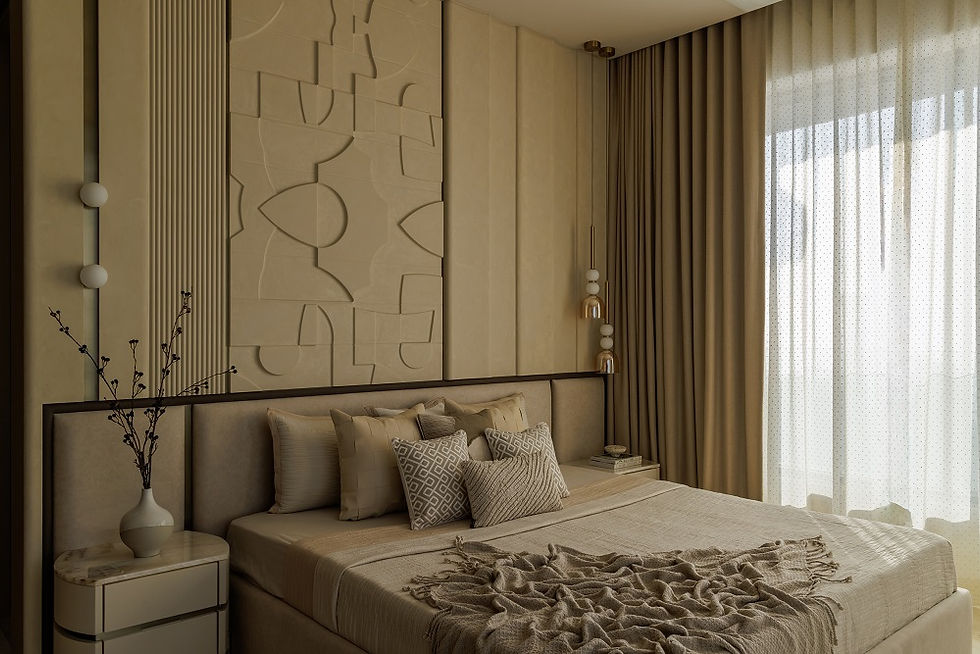
The parent's bedroom works within the same warm neutral palette established across the rest of the apartment. The headwall is the room's most detailed surface: layered panelling in plaster and wood incorporates a three-dimensional abstract textured panel at its centre that functions as integrated artwork rather than a hung piece. Pendant lights with stacked glass and brass elements hang on either side of the bed. Floor-to-ceiling sheers diffuse the natural light from full-height windows, and a botanical wallpaper panel on the adjacent wall brings in a soft figurative element in dialogue with the greenery visible outside. The overall atmosphere is quiet and contained, the materials doing the work without any single element announcing itself.
A second bedroom takes a cooler and more restrained approach. The wardrobe wall runs floor to ceiling in a consistent light wood grain finish, with rounded corners where the unit meets the adjacent wall, a detail that softens the volume of what is a substantial storage run. A dressing table with a curved mirror frame in a sinuous, organic shape sits beside the wardrobe, its sculptural quality introducing a note of individual character into an otherwise calm room. The marble floor and neutral curtains continue from the rest of the apartment.
The third bedroom introduces a deliberately darker material register, the only room in the apartment that departs significantly from the warm neutral tone established elsewhere. Charcoal-toned cabinetry above a glass-topped desk with a thick single-leg base forms the primary wall composition, and the upper cabinet doors are finished in a textured wave-pattern glass that brings movement and depth into the surface. The desk itself, with its glass top and minimal dark base, sits neatly between the bed and the window wall, functioning as a workspace that does not read as an afterthought within the room.
The bathrooms carry the marble language of the apartment into their own spaces rather than treating them as separate utilitarian zones. The most detailed is the powder bathroom, where onyx-effect stone with warm amber veining runs floor to wall in large format slabs, creating a continuous surface that feels enveloping. The basin is carved from the same stone, sitting on a floating white vanity unit with open shelves below. A brass-framed rectangular mirror hangs above, flanked by two small pendant lights with amber glass diffusers in brass fittings. The combination of the stone, the brass and the warm light gives the bathroom a warmth and materiality that connects it directly to the rest of the apartment rather than separating it from the overall design language.
Across its full extent, Sattva is a project where the restraint is the work. The absence of visual noise is not a default condition but a position held consistently across every room and every material decision, so that the view remains what it was always meant to be: the thing the space is designed around.
Fact File
Project Name: Sattva
Location: Mumbai
Typology and Built-up Area: Residential Interiors, 1800 sq. ft.
Design Firm: The Blue Wall Studio
Photography Credits: Wabi Sabi Studios
You May Also Like