.png)


Dr. Sonal Mansingh Opens KalaYatra 2026 with New Choreographies That Revisit Myth, Nature, and Responsibility

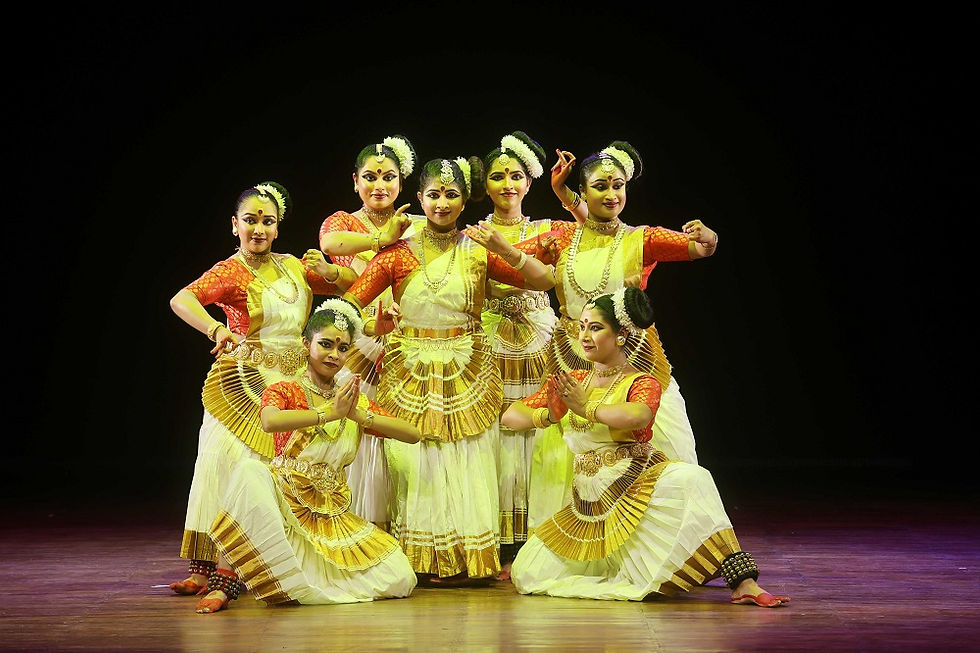
The opening evening of KalaYatra 2026, curated and led by Dr. Sonal Mansingh, unfolded at Kamani Auditorium with a clear emphasis on performance as inquiry rather than spectacle. From the first work of the night, it was evident that the Festival of New Choreographies was less interested in familiar narrative comfort and more invested in how classical dance can speak afresh.
The festival opened with Amrut-Manthan, conceptualised, choreographed, and directed by Dr. Mansingh and performed by repertory artistes of the Centre for Indian Classical Dances (CICD). Drawing from the mythological episode of the churning of the ocean, the choreography avoided literal retelling. Instead, it focused on tension, imbalance, and moral consequence. The movement vocabulary remained grounded in classical discipline, but the pacing and spatial design gave the work a contemporary urgency. Rather than dramatic excess, the choreography relied on restraint, allowing meaning to emerge gradually.

The performance set the tone for KalaYatra’s curatorial intent. New choreography here does not mean novelty for its own sake. It means revisiting inherited narratives with a sense of responsibility. The dancers moved with clarity and control, supported by visual design that remained minimal, ensuring the focus stayed on form and idea.
The opening night audience responded with sustained attention. The hall was full, and the viewing was patient. Classical dance festivals often test endurance, but on this evening, the engagement felt steady. Senior artistes, students, scholars, and practitioners watched closely, not casually. Conversations during the interval revolved around interpretation and structure rather than star presence.

KalaYatra’s format places each Guru and institution in dialogue with the present moment. Over the course of the festival’s first phase, works from different regions and traditions followed, reinforcing this approach. Themes of environmental consciousness, devotion, destiny, and social memory surfaced repeatedly, but through distinct choreographic languages.
The opening phase also underscored the diversity of classical expression without forcing uniformity. Performances from South India and the North-East shared the same platform, not as contrasts staged for effect, but as parallel voices rooted in different cultural lineages. This multiplicity is central to KalaYatra’s design.

Dr. Mansingh’s presence throughout the opening evening was not ceremonial. As curator, she positioned the festival as a space where Gurus take responsibility for new work, acknowledging that classical forms must be allowed to respond to contemporary questions without losing rigour. In her address, she spoke of new choreography as an act of balance, carrying the weight of tradition while allowing renewal.
Beyond the stage, the foyer at Kamani Auditorium reflected continuity rather than nostalgia. A visual display tracing the journey of CICD over nearly five decades contextualised the opening performance, reminding viewers that KalaYatra is not an isolated event, but part of a longer pedagogic and artistic continuum.

As the festival progresses toward its later dates in January, KalaYatra 2026 positions itself as a serious platform for choreographic thought within classical dance. The opening night made it clear that this is not a celebratory showcase alone, but a space where performance becomes reflection. Under Dr. Sonal Mansingh’s direction, the festival reaffirms Delhi’s role as a city where classical dance continues to evolve through discipline, dialogue, and deliberate creation.
You May Also Like


