.png)


Lagori by Yaahvi: A Handcrafted Lighting Collection Rooted in Memory
- Style Essentials Edit Team

- Dec 16, 2025
- 3 min read

Lagori is a childhood game most Indians remember instinctively rather than intellectually. The game involves stacking seven stones, knocking them down, and then rebuilding them again. Balance, interruption, repetition. For Nikita Bansal, founder of Yaahvi, that rhythm stayed long after childhood, shaped by afternoons spent playing the game in Assam, and it now finds form in a new handcrafted lighting collection that carries the same sense of tension and reconstruction.
The Lagori collection includes two chandeliers, floor lamps, table lamps, hanging lamps, and a wall lamp. Rather than illustrating the game directly, the designs work with its physical logic: stacked elements, suspended forms, and compositions that appear stable only because they have been carefully resolved. “Lagori was one of those games that taught me balance and anticipation without ever putting it into words,” says Bansal. “The way the stones wobbled, collapsed, and rose again stayed with me. With this collection, I wanted to translate that rhythm into light and create pieces that hold both fragility and strength.”
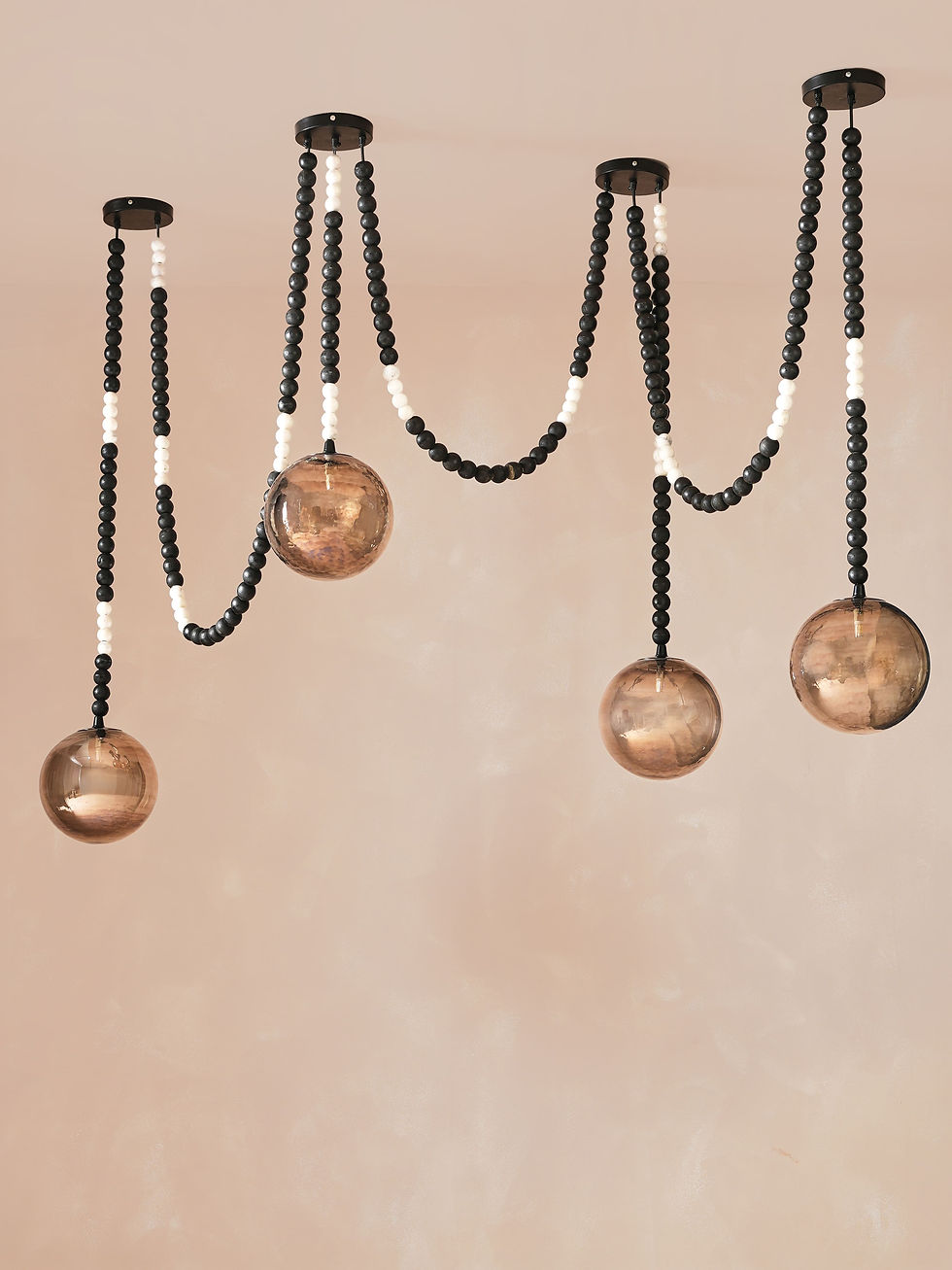
Material choice is central to the collection’s character. Each piece combines double-cast, diamond-cut glass with repoussé aluminum, two materials that operate at opposite ends of refinement and tactility. The glass, produced in black and white, is hand-cut using a diamond tool to create layered patterns reminiscent of banded rock formations. It is a slow, controlled process where precision is essential and variation unavoidable. The repoussé aluminum, by contrast, is shaped through repeated hammering, giving the metal a textured surface that carries visible traces of the hand.
Together, the materials establish a sense of balance rather than contrast. Light filtered through the glass remains soft and measured, while the hammered aluminum provides weight and structure. A restrained black-and-white palette runs through the collection, punctuated by gold and orange accents that introduce warmth without visual excess. All pieces are modular and fully customizable in size and finish, allowing them to be adapted to different interior contexts and scales.

The chandeliers are among the most recognizable expressions of the collection. Clusters of glass forms are suspended in arrangements that echo the precarious stack of Lagori stones, held in deliberate tension. Depending on scale, they can function quietly within smaller spaces or command attention in larger interiors. The table lamps, available in oval and spherical forms, bring this language into a more intimate register, where stacked volumes feel precise yet informal, capturing the pause before balance gives way.
The wall lamp distills the collection’s vocabulary into a compact format, suitable for corridors, niches, and transitional spaces. The sculptural presence becomes more pronounced in the Lagori Gold Floor Lamp, where a repoussé aluminum column and stacked form reflect the physicality of the game itself, the impact that topples the stones, and the instinct to rebuild. The Cluster Hanging Lamp takes a lighter approach, its suspended elements appearing to float, held together by balance rather than symmetry.
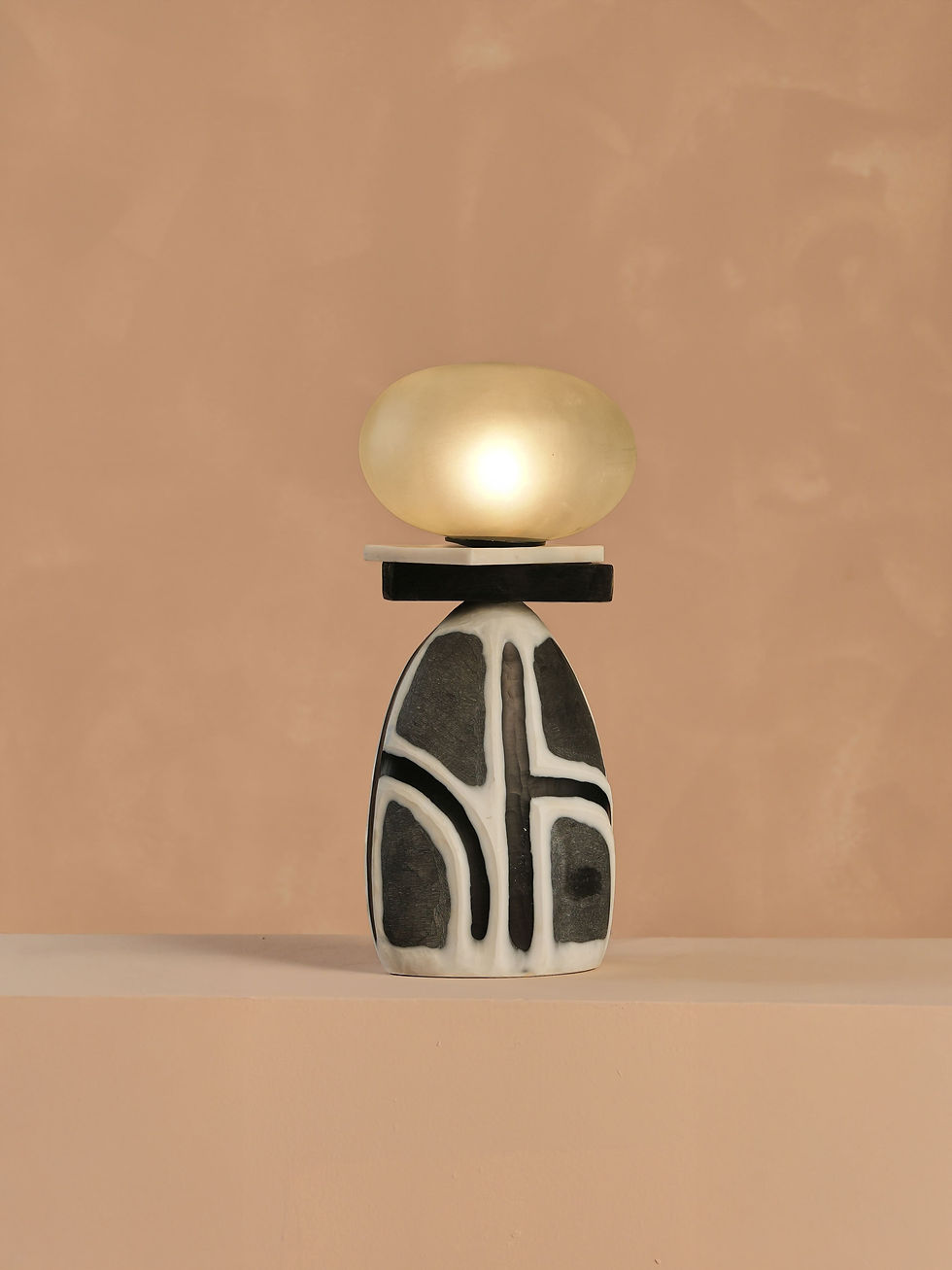
In an interior landscape increasingly dominated by smooth, seamless finishes, the Lagori collection reintroduces texture and material presence. Frosted glass diffuses light gently, allowing the hammered metal and internal glass patterns to remain visible. The lamps function as sources of illumination but also as objects that hold space with restraint rather than spectacle.
“Lagori reminds us that balance is never fixed; it exists in the act of falling and rebuilding,” says Bansal. That idea runs through the collection without being overstated. Fragility and strength coexist, memory informs form, and a simple childhood game is reinterpreted through craft rather than sentiment.
Yaahvi was founded in 2024 by Nikita Bansal and focuses on handcrafted design that brings traditional Indian artisanal techniques into a contemporary context, with an emphasis on material integrity, process, and sustainability.
You May Also Like