.png)


Lena Dunham Met Gala 2026: The Valentino Gown Inspired by a Blood Spatter, a 17th-Century Painter's Survival, and Alessandro Michele's Extraordinary Eye for Detail

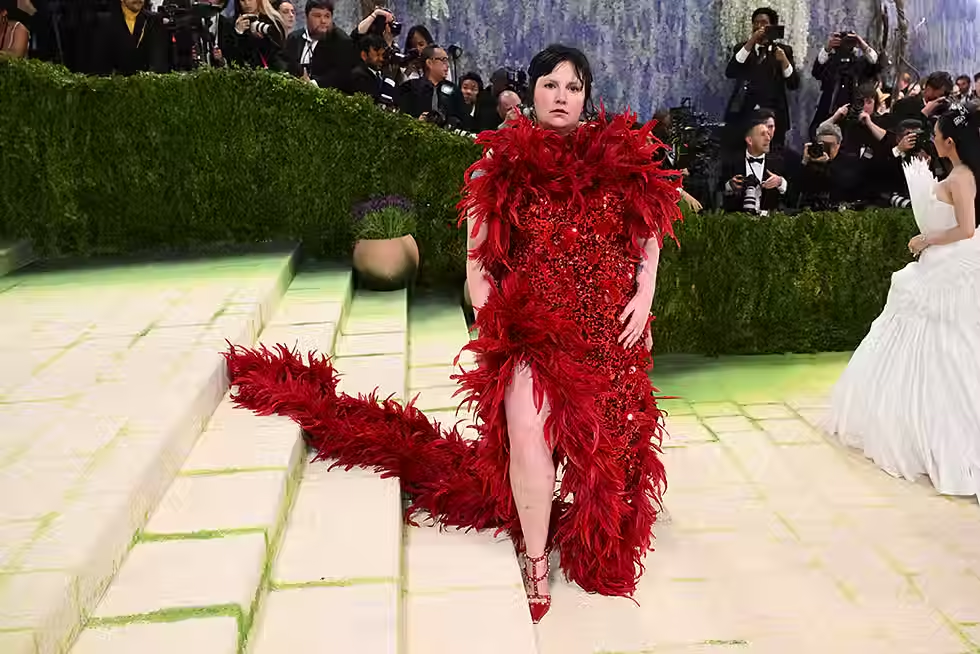
After seven years away from the Met Gala, Lena Dunham returned on the host committee in a custom red Valentino by Alessandro Michele that took its inspiration not from a painting's narrative or its composition but from a single drop of blood on a painted neck. Here is everything behind the look.
Lena Dunham's last Met Gala appearance before 2026 was in 2019, when she attended the Camp: Notes on Fashion edition alongside her Girls costar Jemima Kirke, both in graphic-printed minidresses from Christopher Kane. In the years between, she wrote about what that absence actually contained in her memoir Famesick, which had reached number one on the New York Times bestseller list by the time she walked the 2026 carpet: chronic illness, endometriosis complications that hospitalized her after the 2017 Met Gala, a period in rehab that she attended the 2018 event from, addiction, and the long process of finding her way back. In the book, she wrote that she stopped receiving invitations after 2019.


Her return to the host committee in 2026 came from Anna Wintour, who knew what she had been going through. "I felt like they were saying, 'We see you're feeling better. You're in your body. You can do this," she said on the red carpet. "It's an honor to be invited, and I want to rise to the occasion when I can."
The inspiration behind the look is what sets it apart from every other red dress that walked those steps that evening.
Artemisia Gentileschi: The Artist Behind the Look
The painting that Dunham brought to Alessandro Michele as the starting point for her gown is Judith Slaying Holofernes, made by the Italian Baroque painter Artemisia Gentileschi around 1620. Understanding who Gentileschi was is inseparable from understanding what the painting is and why Dunham chose it.
Gentileschi was born in Rome in 1593, the daughter of the respected painter Orazio Gentileschi, who recognized her extraordinary talent early and provided her with access to training that very few women of her era received. At seventeen she was raped by Agostino Tassi, a colleague and collaborator of her father. The subsequent trial, which her father pursued, subjected Gentileschi to a form of torture during her testimony, her fingers bound with cords twisted tighter as she was questioned, a method used at the time to verify that she was telling the truth. She maintained her account throughout. Tassi was eventually convicted, but his powerful connections ensured he served no meaningful punishment.
Gentileschi returned to her work. The painting she created in the years that followed depicts the Biblical story of Judith, a Hebrew widow who used her beauty and courage to gain access to the Assyrian general Holofernes and then beheaded him to save her people. The subject was common in Baroque painting. What was unusual was how Gentileschi painted it. Where other painters of her era showed the moment with varying degrees of drama and compositional distance, Gentileschi placed the action at its most visceral point: Judith and her maidservant Abra actively gripped Holofernes as his blood poured from the wound, their expressions composed and determined rather than horrified or reluctant. The two women are not passive. They are working.
Art historians have written about this painting for decades in the context of Gentileschi's biography, reading it as her reclamation of power and agency following the violence done to her and the injustice of the trial that followed. Whether or not that reading was Gentileschi's conscious intention, the painting carries it. It is a work about women who act, made by a woman who understood what it costs to do so.
The Gown: What Michele Did With It
Dunham approached Alessandro Michele through a letter. "I wrote him a long, elaborate fan letter about what his work means to me," she said on the red carpet. "I was lucky enough that he responded and said that he was up for the task."
She shared the Gentileschi painting as her inspiration, expecting perhaps an interpretation that drew on the Renaissance garments, the weaponry, or the compositional drama of the biblical scene. Michele looked at the painting and found something else entirely. Rather than leaning into any of those obvious reference points, he was drawn to a specific blood spatter on the neck of Holofernes, a detail so precise and so removed from the painting's broader narrative that most viewers would not isolate it as a reference point at all. From that single abstract detail he built the entire color and texture language of the gown.
The color is not a bright theatrical red. It is a deep crimson, closer to the color of dried blood than fresh paint, and that precision of tone is what makes the Gentileschi reference sit so accurately inside the gown without needing to announce itself. The sequins covering the body of the dress carry that crimson throughout the midsection and skirt where they are most visible, but the crow feathers that frame the neckline, cover the shoulders and upper arms completely, and run in dense, voluminous waves down both sides of the long train dominate the upper half of the look so thoroughly that from any normal viewing distance, the gown reads as more feather than sequin. The feathers thicken toward the hem of the train, which spreads wide across the floor behind her rather than falling in a narrow column. The overall silhouette from the front is one of extraordinary volume across the shoulders and arms, narrowing through the sequined midsection, and then opening again into the wide, feathered train behind it.
A thigh-high slit breaks the skirt on one side, and through it the Valentino Garavani Rockstud strappy heeled sandals in the same deep crimson are clearly visible, their color a precise match to the gown. The Rockstud, a signature shoe of the 2010s, has been making its way back into high fashion, and Dunham wearing it to the Met Gala on her return after seven years makes a specific cultural point about the era she stepped away from and the one she is stepping back into.
Her dark hair was pulled into a half updo, a clean and deliberate styling choice that kept the focus entirely on the dramatic volume of the feathers and the sequined surface of the gown rather than introducing any competing element at the head.
Michele offered Dunham two interpretations of the inspiration, one straightforward and one abstract. "Obviously, that's what I was going to choose," she said of the abstract version. I love how playful he is while also possessing an incredible amount of technical skill, a sense of humor, and the ability to take things very seriously. I feel this dress embodies all of it."
The decision to abstract the reference rather than illustrate it is the most intelligent thing about the creative process behind this look. A gown that depicted Judith or Holofernes directly would have been a costume. A gown that takes the painting's most specific and overlooked visual detail and translates it into deep crimson sequins and crow feathers is something considerably more interesting: a piece of clothing that carries an art historical reference without announcing it, that rewards the viewer who knows the painting and communicates something entirely different to the viewer who does not.

The Return
Dunham's absence from the Met Gala was not a deliberate withdrawal. She wrote in Famesick that she stopped being invited after 2019 and that the years between contained more physical and personal difficulty than she had previously disclosed. She described her 2026 appearance on the host committee, alongside Gwendoline Christie, Angela Bassett, Sabrina Carpenter, and others, as a kind of restoration. Wintour's invitation was, in her reading, an acknowledgement of that recovery.
The look she chose for the evening is consistent with that reading. It is a painting about a woman who reclaimed her agency. He was a designer whose work she had admired for long enough to write him a fan letter. A gown the color of blood that boldly occupies space. After seven years away, and everything those years contained, the choice of Artemisia Gentileschi as the starting point was not incidental.
One Notable Parallel on the Carpet
Nicole Kidman, attending as co-chair in custom Chanel, arrived in red sequins and feathers that evening. The visual similarity between the two looks drew widespread notice. Kidman's Chanel and Dunham's Valentino operated in the same color and material register without any coordination between them, and the fact that the two most prominent women in red sequins and feathers that night were the co-chair and a host committee member, both making significant returns to the event, is a coincidence the carpet seemed entirely unbothered by.
Credits: Gown: Valentino by Alessandro Michele (custom) / Shoes: Valentino Garavani Rockstud / Image Courtesy: Lena Dunham Instagram / Valentino Instagram
You May Also Like
Gwendoline Christie Met Gala 2026: The Giles Deacon Gown, the Gillian Wearing Mask and the Question of Who We Are When We Cover Our Faces Beyoncé at Met Gala 2026: The Crystal Skeleton, the Headpiece and the Feathered Train That Took Several People to Carry Diya Mehta Jatia Met Gala 2026: The Mayyur Girotra Gown That Brought Bengal's Nearly Extinct Shola Craft to the World's Most Watched Red Carpet Venus Williams Met Gala 2026: The Swarovski Gown She Built From Her Own Smithsonian Portrait


