.png)


What Is Modern Art, Actually


A straightforward answer to the question that most people are too embarrassed to ask out loud
You have stood in front of it at least once. A canvas, perhaps entirely white, or covered in a field of one color with a faint variation you can barely see, or marked by a few lines that appear to have been made quickly and without apparent effort. The price on the wall beside it, or the price you read about afterward in a newspaper, is somewhere between incomprehensible and offensive. You look at it for a while. You look at the people looking at it. Some of them appear to be having a genuine experience. You are not sure if they are or if they have simply decided that this is what having a genuine experience in a gallery looks like. You leave feeling faintly ridiculous, unsure whether you have missed something important or whether you have just spent twenty minutes in front of an extremely expensive practical joke.
This is an entirely reasonable response, and it deserves an honest answer rather than the usual combination of art world mystification and defensive enthusiasm. The honest answer has two parts. The first is that modern abstract art is doing something real and the people who made it were often thinking very seriously about what they were trying to do. The second is that the market for this art has almost nothing to do with the art itself and operates on entirely different principles. Understanding both parts does not require any particular background in art history. It requires only the willingness to take the question seriously.

The story begins not with a sudden decision to stop painting things that look like things, but with a problem that photography created the moment it was invented. Before the camera existed, the primary skill that painting and drawing claimed, the skill that took decades to learn and that separated a master from an amateur, was the ability to represent the visible world with accuracy. A portrait that looked like the person. A landscape that captured the light on a particular hill at a particular hour. A still life so precise that you could almost reach into the canvas and pick up the fruit. Photography did this instantly and without training and more accurately than any human hand could manage. The question that every artist working after the mid-nineteenth century had to answer, whether they articulated it or not, was what painting was for now that the camera existed.
The answer that the most radical artists arrived at, working across Europe in the early decades of the twentieth century, responding to a world that was simultaneously being transformed by industrialization, by the violence of modern warfare, by the collapse of old religious and social certainties, was that painting could do something the camera fundamentally could not. It could represent not what the world looks like but what it feels like to be inside the world. It could make visible things that have no visible form, emotion, spiritual experience, the quality of a particular consciousness encountering existence. It could stop being a window onto something else and start being an object in itself, a thing with its own presence and its own argument, made of color and form and the particular mark of a specific human hand.

This is not an abstract idea even though it produced abstract art. Think of the difference between a photographs of a person crying and actually being in the room with someone who is crying. The photograph is more accurate in every technical sense. The experience of being in the room is incomparably more real. What the painters who stripped away representation were trying to do was create the equivalent of being in the room, an encounter with something immediate and embodied and impossible to fully translate into language, rather than looking at a photograph of it. When it works, and it does not always work, you feel something in a canvas of two blurred rectangles of color that you cannot explain and cannot entirely account for, and the feeling is not unlike the feeling of listening to music, which also has no visible form and which we accept entirely on its own terms.
Whether the artists who followed this logic always achieved what they were aiming for is a different question. Some of what sits in galleries under the category of modern abstract art is genuinely powerful. Some of it is genuinely not. The difficulty for the uninitiated viewer is that there is no reliable visual signal distinguishing one from the other, because the whole point of the form is that it does not communicate through the familiar language of representation. This is not a conspiracy. It is simply what happens when an art form abandons the most universal tool of communication, the depiction of recognizable things, in favor of something more direct and more difficult. Learning to see it requires time and exposure and a certain amount of willingness to feel confused before you feel anything else. This is true of jazz, of contemporary classical music, of poetry in translation. It is not unique to painting.

The money, however, is another matter entirely, and the money deserves to be addressed directly because it is the thing that most corrodes the ability to have a genuine relationship with the work.
The price of art is not determined by the quality of the art. This sounds like a cynical statement but it is simply a factual one. Price in the art market is determined by a combination of factors that have varying and often surprisingly small relationships to the work itself. The reputation of the artist, which is built by galleries, critics, institutional collections, auction house marketing and the accumulation of critical attention, is the primary driver. The rarity of the work matters, since a living artist can always make more work and a dead artist cannot, which is why prices for the work of deceased artists often rise significantly and immediately after death. The provenance of a specific piece, who owned it before you, whether a significant museum has exhibited it, whether it has appeared in a major publication, adds value independently of anything about the work's visual or intellectual character.
Auction houses operate on the logic of luxury brand marketing rather than aesthetic judgment. They create events around sales, build narratives around lots, and depend for their business model on the belief among buyers that acquiring a particular work is a form of social and cultural positioning as much as an aesthetic experience. The result is that the most expensive works in the world are not necessarily the most important works, and the most important works are not necessarily the most expensive ones, and anyone entering the art market as a buyer without understanding this distinction will make decisions they cannot entirely justify on any terms other than status.

None of this means that the works being traded for extraordinary sums are without merit. Many of them are genuinely significant. But the significance and the price are parallel tracks that sometimes intersect and sometimes do not, and confusing one for the other produces most of the frustration and mystification that surrounds modern art in general conversation. When someone pays a sum equivalent to a small nation's GDP for a canvas that appears to contain very little, what they are doing is not necessarily recognizing the depth of that canvas. What they are doing is acquiring a position in a market and a social system that confers prestige on that acquisition, in a world where prestige is one of the few things that extreme wealth cannot directly manufacture and must instead purchase from the institutions that have the authority to bestow it.
This is why the same work that sells for many millions at auction would generate almost no response if you hung it unsigned in your own home and invited your friends to look at it. The painting has not changed. What has changed is the institutional apparatus that tells you what it is worth and why. The painting alone, without the gallery, the auction record, the critical history, the provenance, the art fair placement, the magazine coverage, is just paint on canvas. All art is just its materials until the human systems that surround it tell you otherwise. This is not unique to modern art. It is true of every art form in every culture in every period of history. Modern abstract art simply makes the machinery more visible because the work itself provides fewer familiar anchors to hold onto.
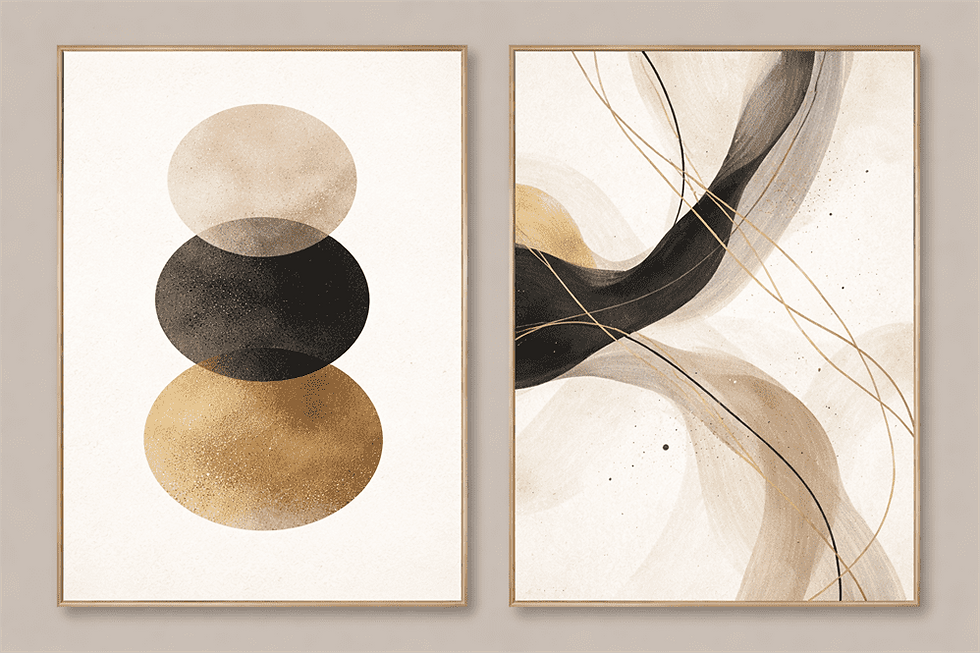
The most useful way to stand in front of a piece of abstract art, whether in a gallery or reproduced on a page, is not to ask what it represents or what it is worth or whether you could have made it. It is to ask what it does to you. What happens in your body in its presence? Whether the color produces any quality of feeling. Whether the marks carry any quality of energy or intention that you can register even if you cannot describe it. You may feel nothing, and this does not mean you have failed. It may mean the work is not doing what it set out to do, or it may mean that you are not yet equipped to receive what it is offering, or it may mean that this particular work is simply not speaking to you in the way that another work from the same tradition would. All of these are equally valid conclusions.
The people who made the most important abstract work in the last hundred and twenty years were often driven by a seriousness of purpose and a genuine inquiry into what art could do that compares favorably with the seriousness of purpose in any other creative discipline. The market that has grown up around their work, and around the work of those who came after them, is a different thing entirely, driven by money and status and the particular dynamics of a luxury market that has more in common with fine wine or rare watches than with the artistic ambitions of the people whose work it trades. Understanding the difference between the art and the market does not make the art easier to love. But it does make it considerably easier to approach without the mixture of suspicion and inadequacy that most of us feel when we stand in front of something expensive that we do not understand.
The canvas is doing something. Whether it is doing it well enough to justify the price on the label is a question you should feel entirely free to answer for yourself.
You May Also Like
Gwendoline Christie Met Gala 2026: The Giles Deacon Gown, the Gillian Wearing Mask and the Question of Who We Are When We Cover Our Faces Beyoncé at Met Gala 2026: The Crystal Skeleton, the Headpiece and the Feathered Train That Took Several People to Carry Diya Mehta Jatia Met Gala 2026: The Mayyur Girotra Gown That Brought Bengal's Nearly Extinct Shola Craft to the World's Most Watched Red Carpet


