.png)


Enter this 3,200 sq ft Chennai home where every curve celebrates craft and fluidity


There are homes that try to impress you in the first minute, and others that unfold at their own pace, the way a familiar song does when you hear it after years. This 3,200 sq ft apartment in Chennai belongs to the second kind. Designed by Anahita Rattha of A Design Theory, it doesn’t rush to declare its style or its philosophy. Instead, it lets surfaces and contours reveal themselves gradually—sometimes in the quiet of a curved ceiling, sometimes in the slow sweep of a parametric wall that behaves almost like it’s breathing.

The brief wasn’t about creating a showpiece. It was about building a space that understood the texture of everyday living—heat-softened afternoons, light that wanders from room to room, the comfort of objects that are handmade rather than machine-perfect. The first thing visitors encounter is rattan: warm, familiar, almost nostalgic. Cabinets with woven fronts, pieces of custom-made furniture that feel like they carry some memory of older, slower homes. It’s the kind of material that doesn’t pretend; it just settles into a room and lets people settle with it.

Then you see something else, almost like a counterpoint—the parametric forms. These are not loud statements but quiet shifts in geometry, rising and falling in smooth forms that guide the gaze without demanding it. Digital precision, softened by intention. “We wanted the home to feel alive,” Anahita says, though she doesn’t mean it metaphorically. She means a space that reacts to people, that expands when family gathers, that tightens into stillness when everyone retreats into their evenings.
Colours stay close to the earth. Polished concrete underfoot, limewash that absorbs light instead of bouncing it back, ceramics placed almost absentmindedly on shelves, as though someone had collected them over years rather than curated them in one go. The greenery is not ornamental but intuitive—plants placed where they simply make sense, softening edges, offering a bit of shadow to a bare corner. Nothing is forced. Nothing feels like a prop.

The living area stretches with a kind of quiet generosity. There’s no desire to create a grand statement; instead, the room feels like it has been shaped by conversations, late-night chai, cushions moved around by restless hands. The modular sofa is adaptable in the way modern homes demand—pieces shifting for a movie night, a family visit, or the kind of get-together that begins in the afternoon and ends without anyone noticing the time. The parametric walls, in this light, begin to feel less like a design flourish and more like an atmosphere—curves echoing curves, shadows moving softly across them from large windows that frame the day as it changes rhythm.
The dining area isn’t treated as a formal zone. It eases out of the living space, much like how gatherings begin without ceremony. The extendable table sits ready to respond—two people on a weekday or a dozen on the weekend. Materials continue their conversation here: cane, wood, touches of rattan that tie back to the entry. The kitchen follows a similar language, practical but warm. Storage is tucked behind cane-panelled shutters, creating a rhythm that stays consistent with the rest of the home. It’s a kitchen that doesn’t announce its efficiency, but you sense it as you move through it—everything within reach, nothing over-designed.

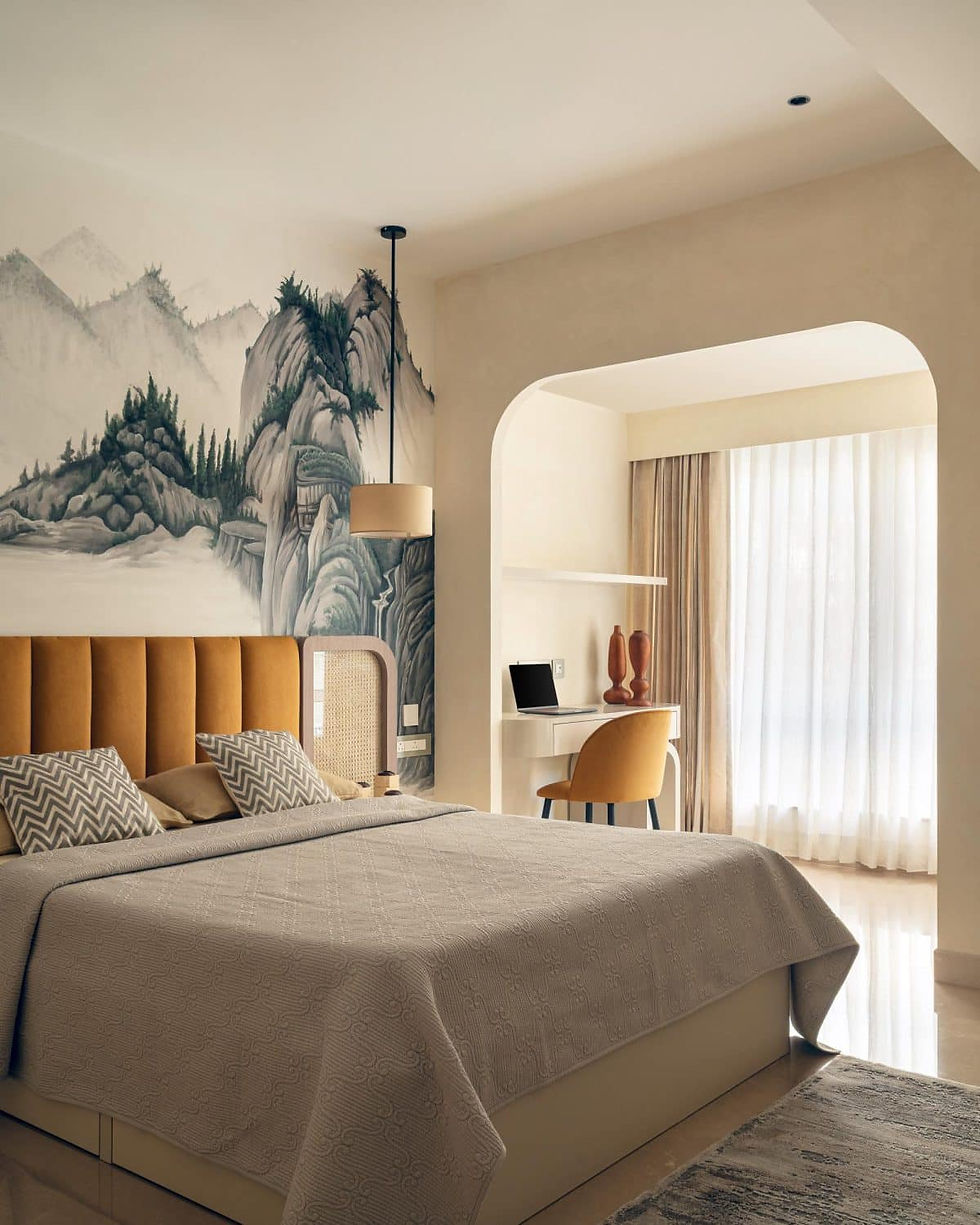
The bedrooms change tempo entirely. They are slower, more inward spaces. Curved wooden ceilings lower the scale and soften the acoustics, wrapping each room in a gentle hush. Beds become sculptures in their own right—some with cane insets that play with shadow, others upholstered with fabrics that absorb afternoon light. One bedroom carries hand-painted walls, a personal touch that feels unstudied, almost like someone left a story on the plaster. No two rooms feel the same, yet they belong to the same narrative. “Each one needed its own mood,” Anahita says, “but we didn’t want them to drift apart.” They don’t.

The bathrooms follow their own path of refinement. Rose quartz in one, Italian marble in another, mirrors shaped not by symmetry but by a sculptural instinct. The lighting avoids the temptation to dramatise; it stays close to the surfaces, creating an intimacy that feels closer to candlelight than to electricity.
If the home has a soul, it sits in the pooja room. Everything here slows down—the air, the sound, even the light seems to settle more softly. A mother-of-pearl arch shimmers without sparkle, almost like the inside of a shell that has held a memory for too long. The sanctum steps inside recall temple architecture, though reinterpreted with a fresh precision. Behind it, marble etched with traditional motifs draws the eye inward. The threshold is equally considered: brass inlay on the doors, fluted glass that seems to glow from within, and handles that carry the weight of craft rather than ornament.

Walking back into the social areas, you begin to understand what anchors the home. It is not the materials, even though they are beautiful. It is not the parametric forms, although they give the home its fluid character. It is the balance—an unhurried, lived-in balance between the digital and the handmade, the sculptural and the tactile, the coolness of concrete and the warmth of rattan. It is a home that behaves like people do: shifting, resting, opening, quietening.
Elaris 201 doesn’t fit into a category. It doesn’t chase trends or mimic global styles. Instead, it absorbs influences and distils them into something unmistakably contemporary yet rooted in Indian craft. Every room feels like it has been shaped by hands and thought in equal measure. Every curve feels intentional rather than ornamental. And every surface carries a remark of the life that will unfold around it.
It is a modern home, yes—but it is also a reminder of what modernity can feel like when it remembers where it came from.
Fact file:
Project Name: Elaris 201
Project Type: Residential
Project Location: Chennai, India
Designed & Executed by: A Design Theory
Principal Designer: Anahita Rattha
Area: 3,200 sq ft
Photography: Yash Jain
You May Also Like