.png)


FROM PAINT TO PATTERN: Neha Jain of UDC Homes

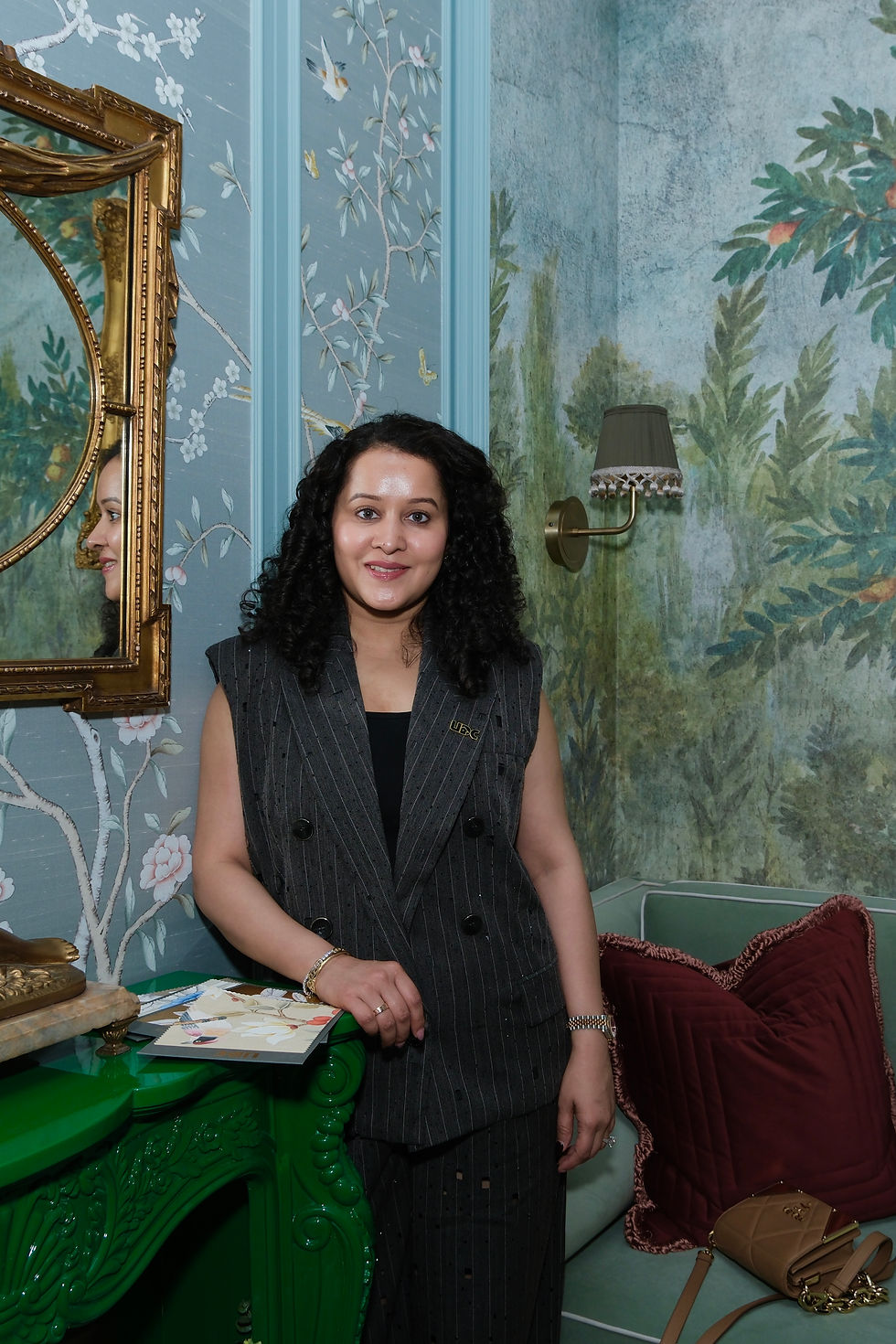
She studied economics at Warwick, spent years reading spreadsheets in a multinational company, and then walked into the décor industry, where she quietly remade it. Neha Jain, co-founder of UDC Homes, speaks to Alisha of Design Diary International on transforming a paint retail business into one of India's most ambitious wall covering brands, and what it takes to design surfaces that outlast the moment they were made in.
In 2014, a paint retail company that had spent a d2023, UDC Homes began exporting wallpapers to the United States and Dubai, a move that represents not just geographic expansion but a statement of intent that what has been built here is not a regional product dressed up for export,ecade selling color to Indian homes did something that paint companies do not typically do. It started designing wall coverings. The person behind that decision was Neha Jain, 37, co-founder of UDC Homes, who had arrived at the business not from design school or an apprenticeship in someone else's atelier but from a career in financial analysis, armed with a degree in economics and finance from Warwick Business School and the particular kind of market vision that comes from being trained to see gaps before they become obvious to everyone else. When Design Diary International reached out to Jain over email, what came back was a portrait of a founder who speaks about surfaces and spaces with the same precision she once brought to balance sheets and whose answers reveal a design philosophy that is more architecturally rigorous, more technically serious, and more culturally considered than the wall covering category typically demands of itself.
The gap she saw in 2014 was specific. India had paint. India had access to international wallcovering brands at a price point that excluded most of the market. What India did not have was premium, customized wall coverings designed with Indian sensibilities, built to Indian climate conditions, made in India. UDC Homes decided to make them and, in doing so, transformed itself from a retail business into a design one, from a company that sold other people's surfaces into one that authored its own.
The company itself was not new when it made that decision. UDC Homes had existed for twenty-five years, had built a substantial reputation as one of India's largest paint retailers, and had the kind of market presence that takes a long time to establish and an even longer time to meaningfully redirect. Redirecting it anyway, and in the direction of a product category the company had never touched, required a clarity of conviction that Jain describes with characteristic plainness. Clients wanted more than color on their walls, she says. Design awareness had grown to the point where people no longer treated walls as backgrounds. They were becoming statement elements. And the market was not keeping up with that shift. The decision to move from selling surfaces to designing them was, in that reading of the situation, not a gamble but a logical response to something that was already happening and simply had not been adequately answered yet.
What followed was not an overnight transformation. The wall coverings division launched in 2014 and spent the better part of a decade building its design language, its production process, and its understanding of what premium means in the Indian context and what it needs to mean in international ones. In 2023 UDC Homes began exporting wallpapers to the United States and Dubai, a move that represents not just geographic expansion but a statement of intent that what has been built here is not a regional product dressed up for export but a design proposition confident enough to stand alongside whatever the global market places next to it. The ambition Jain articulates for the next five years, positioning UDC Homes among the top ten wall-covering brands globally with display centers in key metropolitan markets, is significant, and she states it without qualification or the softening language that founders sometimes reach for when the target is large enough to invite skepticism.

"There was a clear gap in the market for customized, premium wall coverings that matched both global standards and Indian design sensibilities."
The design philosophy that underpins all of this work is more architecturally rigorous than the wall covering category tends to demand of itself. Jain talks about the wall the way a structural engineer talks about a load-bearing element, as the thing that sets proportion and scale and mood before any other decision in the room has been made as the foundation from which everything else is read rather than the surface onto which everything else is projected. In many of our projects, she says, the wall sets the tone before furniture or décor is added, and that sequencing matters to her: the wall first and everything in conversation with it rather than the wall last and everything already decided. Wallpaper, in this account of its own function, is not ornament. Architecture is expressed through surface, detail, and storytelling. This distinction is not merely semantic; it is a design principle that runs through every stage of how UDC Homes develops its collections, from the first research conversation to the last quality check before a product goes to market.
That development process is longer and more considered than the finished product might suggest. A design moves through six to eight detailed stages before it reaches the market, starting with initial research into trends, architecture, culture, and client preferences; followed by sketches, digital artworks, and careful refinement of scale, color palette, and repeat patterns; then material selection and surface testing; next physical samples, prototypes, and multiple rounds of quality checks and revisions; and finally, only after final approvals and performance testing, does anything move into production. This process reflects Jain's analytical instinct from financial analysis: an insistence on testing and evidence, only proceeding when something actually works. This rigor is often underappreciated in the creative context, where it is more necessary than the industry acknowledges.
Performance in Indian conditions is a subject she addresses with technical specificity because it presents a problem. UDC Homes has genuinely solved it rather than worked around it. Humidity, temperature fluctuation, the adhesion demands of older wall constructions, and the maintenance realities of everyday households across different Indian climates—all of these are variables built into material selection from the earliest stages of product development, not considerations added after the design is finished but part of the same conversation as the visual and the conceptual from the very beginning. A wall covering that fails in three years in an Indian summer is not a luxury product regardless of how beautiful it looks on a wall in a photograph, and the durability Jain describes is not a technical footnote appended to something more important; it is part of what the design is, inseparable from the surface itself and from the promise the brand makes to the client who invests in it.
"Durability, texture, finish, and ease of installation are essential to luxury. They are never secondary."
The cultural dimension of UDC Homes' design language is where the brand's identity becomes most carefully constructed and most worth examining. Jain navigates the relationship between Indian cultural reference and contemporary design with a precision that avoids both of the obvious failures available to her: the one where Indian motifs are applied to surfaces as illustration or costume rather than identity and the one where cultural specificity is dissolved entirely in pursuit of an international legibility that ends up belonging nowhere in particular. Sometimes the inspiration is direct, she explains, a conscious reinterpretation of Indian heritage art forms or traditional architecture carried into a contemporary context, and sometimes it is more subtle, present in color palettes and rhythmic patterns and a quality of craftsmanship that feels rooted without announcing itself. Culture does not always need to be loud to be meaningful, she says, and whether the reference is bold or understated, the aim is consistent: designs that carry a sense of identity and authenticity while feeling modern and globally relevant, surfaces that know where they come from without being defined entirely by it.
This balance has become more consequential as the brand has moved into international markets. Designing for global distribution creates its own gravitational pull toward the generic, toward the universally palatable, toward designs that have been smoothed of anything too specific or too rooted to travel easily across different markets and different tastes, and Jain is direct about that tension. Different markets have varied preferences and spatial styles, she says, and versatility and adaptability are necessary, but not at the cost of the character that makes a brand worth seeking out in the first place, the thing that gives it a reason to exist alongside everything else already available to a client in New York or Dubai or Delhi. The response at UDC Homes has been to anchor the work in universal themes, nature, texture, and architecture while weaving through them a design sensibility specific enough to be recognizable as theirs and theirs alone.

The Roman Imperial collection, which Jain identifies as the work that best represents the brand's design philosophy today, illustrates how these priorities resolve in practice. It draws from classical European art and structure, reinterpreted with a contemporary sensibility, and what makes it worth looking at closely is the balance it achieves between strong visual storytelling and refined material execution, between surfaces that are immediate and immersive in their impact and objects that are technically accomplished enough to justify the investment a client makes in them. Timeless design is often a hedge against commitment, but here it describes something more earned: a collection rooted deeply enough in form, proportion, and craftsmanship that it remains relevant without reference to its creation moment, looking as considered in ten years as it does today because it was not designed for today in particular.
"Instead of chasing fast trends, we aim to create designs that feel relevant for years, allowing clients to invest in walls that remain elegant, versatile, and enduring."
Manufacturing constraints, Jain notes, have often produced stronger design outcomes than the original unconstrained concept, and there is something revealing in this observation, something that sounds like the analyst underneath the designer, the person trained early to understand that limitations are data rather than obstacles, that a constraint in texture or color layering or scale is pressure that forces simplification and experimentation the original idea might never have found on its own. The closeness of design and production teams at UDC Homes, the insistence that these are not separate processes but a single conversation running from concept through to manufacture, reflects the same instinct: that what works in reality is the only measure that ultimately matters and that the people who know what works in reality should be in the room from the very beginning, not consulted at the end when the design is already fixed and the only available response to a problem is compromise.
The future she describes for the industry is one of greater immersion, greater intelligence, and greater material sophistication, where digital precision and handcrafted finishes combine rather than compete, where sustainable substrates and performance-driven surfaces that respond to light and climate become the baseline rather than the premium option, and where personalization plays an increasingly central role as clients come to understand their walls as expressions of identity rather than categories of finish to be selected from a sample book. Through all of it, she insists, craftsmanship remains essential, not as nostalgia or a counterweight to technology but as the thing that keeps a surface connected to the room it is meant to serve, that prevents innovation from becoming merely clever, and that ensures the wall continues to be, above all, felt by the person standing in front of it.
To young designers entering the surface design space, she offers advice that reads, in retrospect, like a precise description of the discipline she has applied to herself across twelve years of building this brand. Understand architecture before patterns, she says. Study materials and techniques as deeply as you study design. Do not chase trends. Build from concept and proportion and storytelling. Learn from production teams because they will teach you what works in reality. Stay curious. It is the counsel of someone who came to this field from outside its usual entry points, who had to learn its logic rather than inherit it, and who has spent twelve years applying to it the same rigor she once applied to financial markets, with results that the Indian wall-covering industry had not seen before and that the global market, from New York to Dubai, is only now beginning to encounter.
"Great surface design comes from observation, experimentation, and a genuine passion for detail."
You May Also Like


