.png)


Savor the Grandeur of Indian Royalty in London’s Most Maximalist Dining Destination- Colonel Saab


Colonel Saab doesn’t feel like a restaurant that was “designed” in the conventional sense. It feels more like a place that came together slowly, piece by piece, memory by memory, until it began to resemble a home. Not an ordinary home, but one shaped by travel, inheritance, and a very specific idea of Indian grandeur. Set near Trafalgar Square, it occupies a rare position in London’s dining landscape, not because it is Indian, but because it is unapologetically personal.
The brief itself was emotional rather than trend-driven. The client wanted a space that reflected a lifetime of journeys across India, a relationship shaped by shared travel and collecting rather than consumption, and that intent sits quietly at the core of the interiors. This was never meant to be a generic fine-dining setting dressed up with Indian motifs. The ambition was closer to recreating the feeling of stepping into a royal Indian home, one where objects carry stories, rooms evolve over time, and nothing exists purely to be looked at.
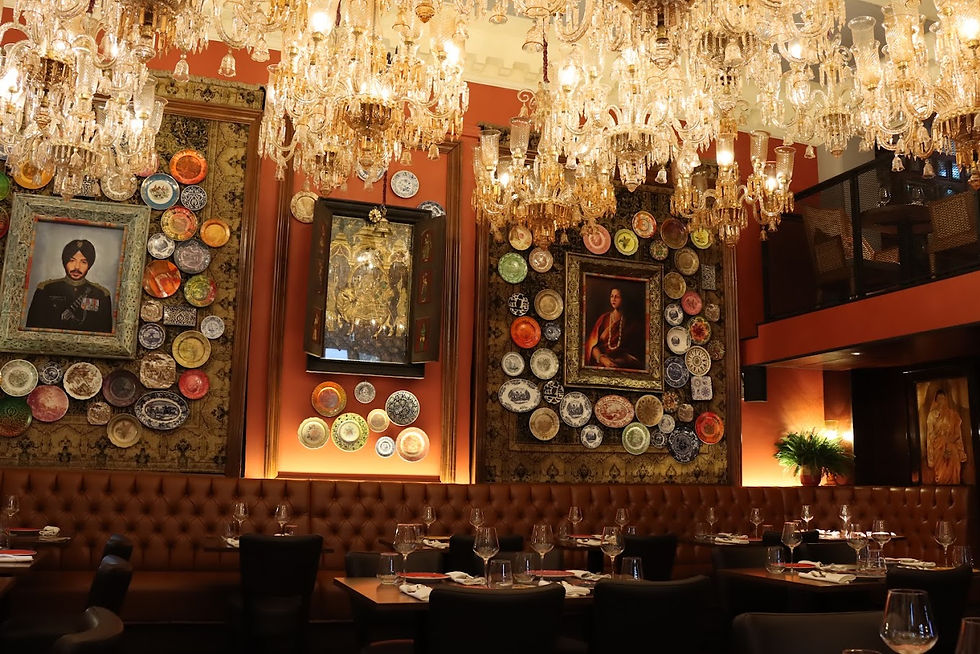
Designed by Tusshar Joshi of Utkarsh Vastukaran Design Studio, the restaurant leans into a kind of maximalism that feels lived-in rather than staged. If there is a design language at work here, it is heritage-infused eclecticism, layered with restraint. Colonial references sit beside Indian royal elements, but neither dominates. Instead, they coexist, sometimes comfortably, sometimes with a little tension, which is exactly what gives the space its depth.
What becomes evident almost immediately is that every corner carries provenance. Jharokhas from Rajasthan appear not as ornamental inserts but as architectural punctuation. Temple doors sourced from Gujarat show their age openly, bearing marks of use rather than restoration. Sixteenth-century Tanjore paintings line the walls, Mughal zardozi embroidery is worked into surfaces, and Persian rugs sit underfoot. None of this is arranged for spectacle. It feels closer to how objects accumulate in a family home over generations, guided by memory rather than logic.

The restaurant unfolds across two floors and seats around 150 guests, yet it never feels like one large room competing for attention. The ground floor opens into an opulent dining hall crowned by a glass atrium that pulls daylight into the heart of the space, preventing the richness from becoming heavy. Chandeliers crafted in Firozabad hang overhead, lending a ceremonial warmth without slipping into excess. Nearby, a bar and lounge area introduces a slower rhythm, offering pause rather than performance.
Upstairs, three private dining rooms occupy the mezzanine level, designed for intimate gatherings and longer conversations. Importantly, these spaces don’t feel cut off. Sightlines remain open, textures repeat subtly, and the experience flows rather than fragments.
Putting this together was far from simple. Sourcing rare antiques and integrating them into a contemporary hospitality environment meant navigating restoration, structural demands, and modern regulations simultaneously. Each artefact required careful placement, not just visually but practically, ensuring it could coexist with lighting, ventilation, and safety systems without losing integrity. Much of the success of the project lies in how invisible these challenges feel to the guest.

Materially, the interiors are indulgent but grounded. Mahogany wood, natural stone, hand-carved white metal, brocade and velvet upholstery, hand-painted murals, etched brass screens, and inlaid mirror work come together in layers rather than statements. Indian artisans played a central role in bringing this vision to life, crafting custom furniture, embroidered banquettes, and architectural details that feel specific rather than outsourced.
Colour is used generously, but with discipline. Jewel tones dominate, emerald greens, deep maroons, royal blues, softened by creams and beiges that allow the eye to rest. These colours don’t shout. They settle. They echo palatial interiors without attempting to replicate them.
Lighting is perhaps the most quietly powerful element here. The space shifts mood across the day, from daylight elegance beneath the atrium to a warm, intimate glow by evening. Traditional lanterns, vintage brass chandeliers, and contemporary fixtures coexist without hierarchy. Nothing competes. Everything collaborates.
What ultimately sets Colonel Saab apart is that it isn’t trying to explain India to anyone. It assumes curiosity. It trusts the guest to notice details, to feel atmosphere, to sit with layers. Elements like jharokhas, murals, carvings, textiles, and artworks aren’t decorative shortcuts; they carry emotional and cultural weight. Warli paintings, antique instruments, and personal heirlooms sit alongside fine dining with quiet confidence.
This is not a restaurant chasing novelty. It is a space built around memory, identity, and affection. In a city where dining often feels transactional, Colonel Saab offers something slower and more considered. It invites people to pause, to look closely, and to experience luxury not as spectacle, but as storytelling.
Fact File
Project: Colonel Saab
Location: Holborn & Trafalgar Square, London, United Kingdom
Total Area: Holborn – 3,500 sq ft | Trafalgar Square – 4,500 sq ft
Type: Hospitality Interior Design
Design Firm: Utkarsh Vastukaran Design Studio, Mumbai
Lead Designer: Tusshar Joshi
You May Also Like